

Don't Scale on a Weak Foundation

Healthcare AI – Driving Clinical Predictions and Compliance with Scalable MLOps

About Client

  • A US-based healthcare technology provider supporting over 200 hospitals and clinical labs.
  • With an annual turnover of over $600 million and operations across North America region, they specialize in clinical decision support systems (CDSS), diagnostic AI tools, and patient risk prediction models.

Problem STATEMENT

During our initial discussions, the client highlighted four critical challenges impacting their model management and automation capabilities:

Inconsistent Model Retraining

The client struggled to keep their AI models, especially those used for patient risk scoring and disease prediction, consistently updated. This led to concerns around clinical accuracy and relevance over time.

Regulatory Compliance Gaps

Without proper audit trails and documentation throughout the ML lifecycle, the client faced increasing compliance risks, particularly around HIPAA and FDA requirements.

Fragmented Model Deployment

ML models were built and deployed in silos by different product teams, making it difficult to manage, monitor, or scale them within a unified clinical framework.

Lack of Real-Time Feedback

Clinicians didn’t have real-time visibility into how models were performing during patient care. This limited their ability to trust or act on AI-driven insights at critical moments.

Solution

To address the client’s challenges, our team of data engineers and AI specialists designed a secure, scalable, and compliant ML infrastructure tailored for clinical environments.
Data Engineering & Integration

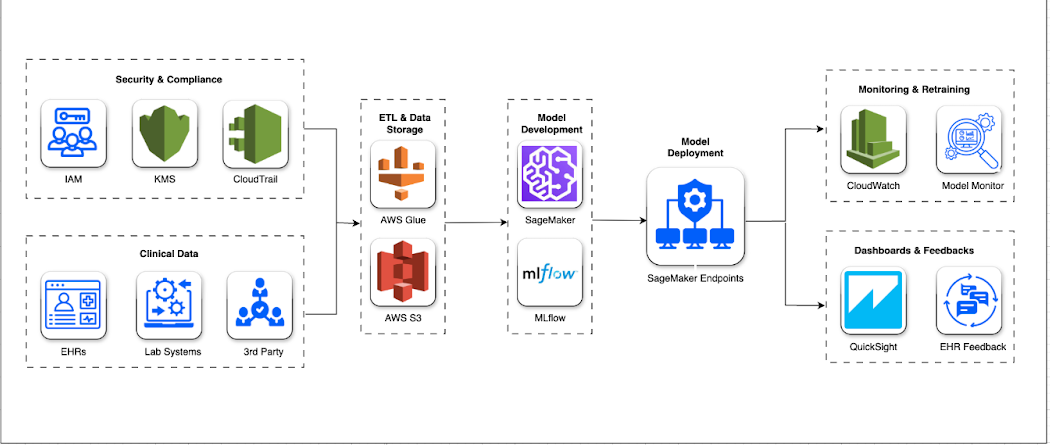
  • To ensure secure and compliant data flow, we built robust ETL pipelines using AWS Glue and Amazon S3, pulling data from EHRs, lab systems, and trusted third-party sources.
  • A Medallion architecture (Bronze–Silver–Gold) was used to maintain data quality, traceability, and validation at every step.

Model Development & Automation

  • Model training, tuning, and deployment pipelines were orchestrated using Amazon SageMaker, with MLflow handling version control and tracking.
  • We set up automated retraining workflows that responded to data drift or clinician feedback, keeping models fresh and clinically relevant.

Data Governance

  • Real-time monitoring was handled through Amazon CloudWatch and SageMaker Model Monitor, enabling quick detection of drift and compliance issues.
  • We also maintained detailed audit logs and model lineage to support HIPAA and FDA audit readiness, with role-based access tightly managed via AWS IAM policies.

Visualization & Clinician Feedback

  • Custom QuickSight dashboards gave clinicians real-time access to predictions, along with confidence scores to support decision-making.
  • We embedded lightweight feedback tools directly into clinical workflows, allowing for continuous model refinement based on real-world use.

Technical Implementation

Cloud Infrastructure & Security

  • Deployed the solution in a HIPAA-compliant AWS environment, ensuring regulatory alignment and data privacy.
  • Implemented AWS KMS for encryption, IAM policies for access control, and CloudTrail for audit logging and FDA traceability.

Data Ingestion & Storage

  • Built ETL pipelines using AWS Glue to extract data from EHRs, lab systems, and third-party sources.
  • Ingested data was stored in Amazon S3, structured with a Medallion Architecture (Bronze, Silver, Gold) to maintain quality and lineage.

Data Processing & Feature Engineering

  • Used PySpark and AWS Lambda for distributed preprocessing and feature engineering.
  • Applied custom logic for missing values, lab standardization, and secure patient data encoding.

Model Training & Deployment

  • Developed and tuned models with Amazon SageMaker, integrated MLflow for versioning and tracking.
  • Models were containerized with Docker and deployed via CI/CD pipelines to SageMaker endpoints for real-time inference.

Monitoring & Drift Detection

  • Enabled live performance tracking with Amazon CloudWatch and SageMaker Model Monitor.
  • Set up automated retraining triggers based on drift thresholds to keep models clinically accurate.

Visualization & Feedback

  • Built interactive dashboards using Amazon QuickSight to display predictions, confidence scores, and patient insights.
  • Integrated in-workflow feedback tools within the EHR system to capture clinician input for continuous model improvement.

Technical Architecture

Clinical Predictions and Compliance with Scalable MLOps Img

Business Impact

Stronger Model Governance

The team achieved full model lineage and version control, improving governance by 80% and ensuring traceability for audits and regulatory checks.

Faster Deployment Cycles

Automated CI/CD pipelines helped cut deployment time from 2 weeks to just 5 days, allowing quicker rollout of clinical AI models.

High System Uptime

With robust monitoring and failover systems in place, AI services maintained 95% uptime, ensuring consistent availability during critical care workflows.

Real-Time Clinical Visibility

Clinicians gained immediate access to prediction results and confidence scores directly within their EHR systems, enabling informed, in-the-moment decisions.

Compliance Confidence

The solution met both HIPAA and FDA SaMD requirements, accelerating time-to-market and clearing the path for broader clinical adoption.

With our developers onboard, the client transformed automation intelligence from scattered experiments into a trusted, compliant engine powering real clinical decisions. Together, we built not just models but momentum for smarter, safer healthcare at scale.

Related Case Studies

Drop Your Business Concern

Briefly describe the challenges you’re facing, and we’ll offer relevant insights, resources, or a quote.

Ankush

Business Development Head
Discussing Tailored Business Solutions

DMCA.com Protection Status