

The company was looking to better their AI-powered project delivery platform, but found themselves in a dilemma. Their roadmap was ambitious, with aggressive timelines for rolling out new features, yet their in-house team lacked the technical bandwidth to move at the required pace. To bridge this gap, they turned to a staff augmentation model, bringing in specialized talent in machine learning, Python, and data architecture. They faced:
The internal team didn’t have the capacity to build, test, and scale machine learning components at the speed demanded by the business.
Parsing and analyzing large volumes of unstructured project documentation required NLP-driven automation, something their existing setup couldn’t support effectively.
To maintain transparency and user trust, the platform needed Explainable AI features that could make model decisions interpretable for non-technical stakeholders.
Model outputs had to be integrated seamlessly into the existing front-end product, but slow turnaround times created bottlenecks in the release cycle.
Without dedicated MLOps pipelines for retraining and deployment, the process of maintaining and scaling models remained manual, inconsistent, and error-prone.
In the process, we embedded a Data Engineer, Data Analyst, Data Scientist, LLM/Chatbot Developer, Power BI Developer, and Project Manager into their workflows. Working as an extended arm of the client’s team, our specialists helped design, build, and operationalize scalable AI components.
Our data scientists developed supervised machine learning models to assess project delivery confidence and risk ratings. These models drew on historical project data and stakeholder inputs, giving teams measurable indicators of project health.
Our developers then built NLP workflows to automate document tagging, summarization, and metadata extraction across project reports, statements of work, and risk logs. This reduced manual review and unlocked insights from unstructured data.
To ensure transparency, we implemented SHAP and LIME explainability methods. These surfaced model decision rationale directly in the platform’s user interface, building trust with end-users.
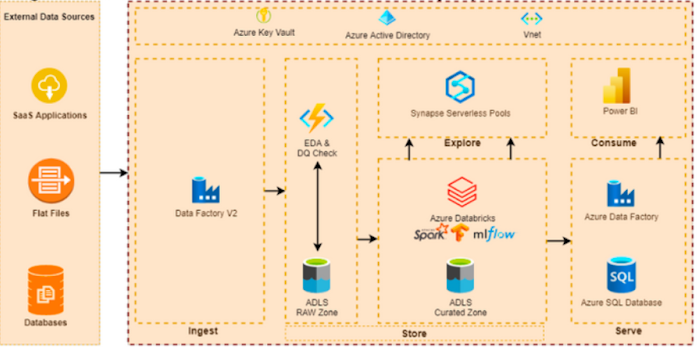
Our developers integrated AI outputs seamlessly into the client’s frontend dashboard using Python-based FastAPI services and standardized JSON endpoints. This made insights instantly accessible within the product experience.
We set up robust MLOps pipelines with version control, automated retraining, and containerized deployment. Using GitHub Actions, models could now be monitored and updated continuously, without disrupting live operations.
Built using Python with Scikit-learn and XGBoost for model development, and FastAPI for API services. NLP capabilities were powered by spaCy and Hugging Face transformers for document intelligence. Deployment was managed through GitHub-based CI/CD pipelines with Docker containers, while lightweight NoSQL storage enabled real-time integration of model outputs.
All data handling followed GDPR standards, supported by anonymization routines for sensitive inputs. API access was secured with role-based controls and logging for full traceability. Comprehensive documentation covered model assumptions, accuracy metrics, and usage guidelines to ensure transparency and responsible adoption.
With external augmentation, the client accelerated delivery across AI modules. Feature rollouts became nearly 40% faster, keeping development aligned with their ambitious roadmap.
NLP-driven automation for document tagging and summarization cut down manual review efforts by about 75%. Teams could now focus on higher-value tasks instead of repetitive checks.
Explainable AI models integrated directly into the UI gave end-users clear visibility into how predictions were made. This strengthened trust and improved adoption across the platform.
With retraining pipelines and automated monitoring in place, models could adapt continuously to new data. This created real-time feedback loops that kept outputs accurate and relevant.
What began as a gap in skills and bandwidth became a partnership with the tech client that delivered faster rollouts, scalable AI pipelines, and greater transparency, showing the real impact of staff augmentation in taking complicated projects forward.
Technology & Software
Europe
Staff/Resource Augmentation
Briefly describe the challenges you’re facing, and we’ll offer relevant insights, resources, or a quote.

Business Development Head
Discussing Tailored Business Solutions

DataToBiz is a Data Science, AI, and BI Consulting Firm that helps Startups, SMBs and Enterprises achieve their future vision of sustainable growth.
DataToBiz is a Data Science, AI, and BI Consulting Firm that helps Startups, SMBs and Enterprises achieve their future vision of sustainable growth.