
The client faced the challenge of building a strong presence in the competitive real estate space. Key issues included:
Limited Market Insights
There was no proper visibility into market trends, pricing, or demand patterns, making it difficult to forecast accurately.
Fragmented Tools & Workflows
CRM, marketing, and transaction management systems were disconnected, causing inefficiencies and slowing operations.
Personalization Gaps
The company struggled to provide data-backed, personalized property recommendations to clients.
Addressing the shared challenges required a coordinated effort from AI/ML engineers, data engineers, cloud architects, and product specialists to design a unified, intelligent solution.
Data Engineering & Integration
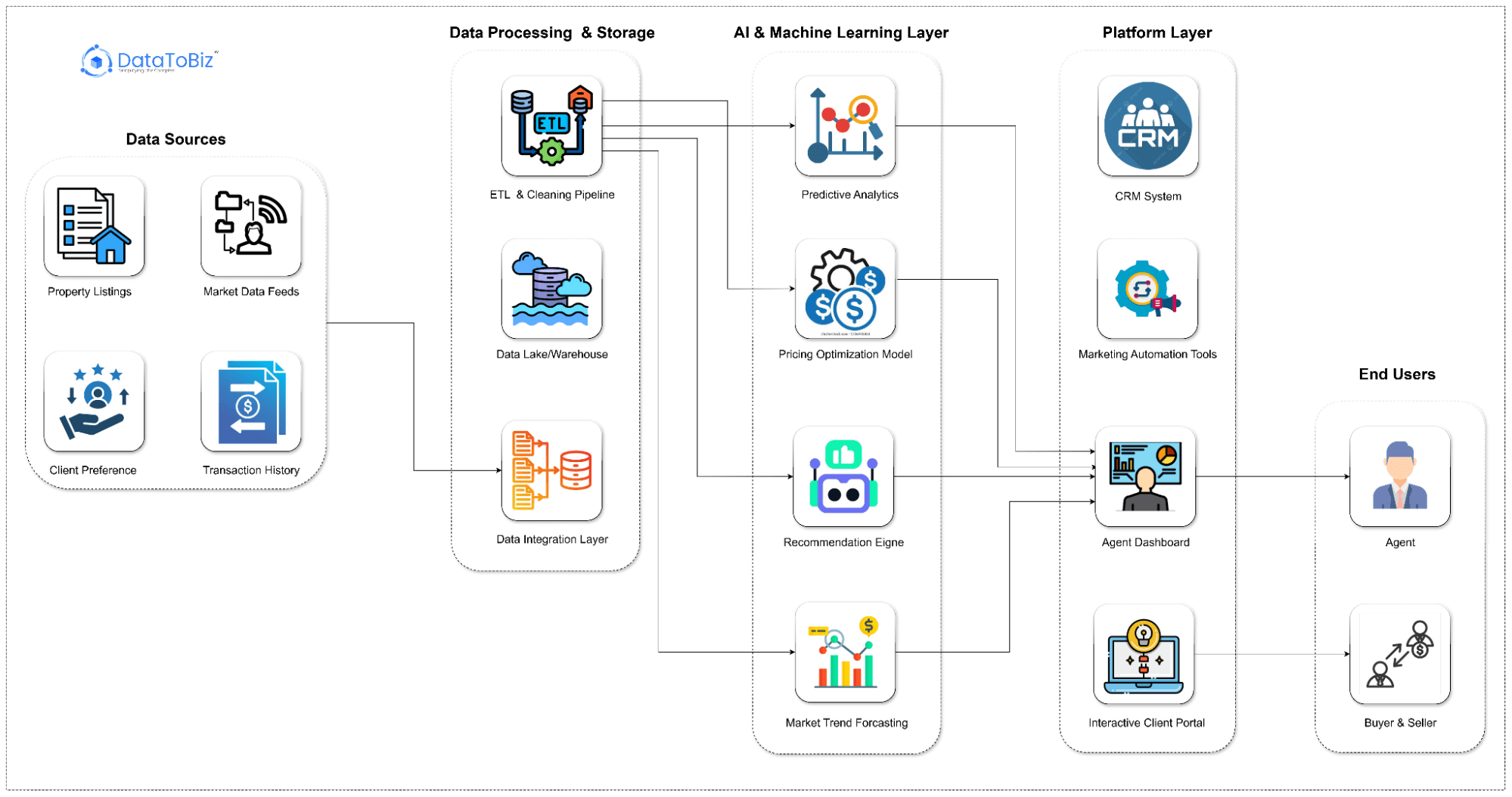
Property listings, transaction history, and client preferences were ingested using AWS Glue and Azure Data Factory, then stored in Azure Data Lake Storage Gen2 with a Medallion Architecture (Bronze, Silver, Gold layers). Real-time property updates were captured via Kafka and Azure Event Hubs.
AI & Predictive Models
Machine learning models built with Scikit-learn and TensorFlow were deployed on Azure Machine Learning. Predictive models supported market trend forecasting, dynamic pricing, and personalized property recommendations, while NLP models (Hugging Face Transformers) analyzed client feedback to generate required suggestions.
Platform & Tools
A CRM module was developed with Salesforce integrations and custom APIs for managing clients and transactions. Agents accessed a Power BI + React.js dashboard for live KPIs and property insights. Marketing automation was integrated via HubSpot APIs and a proprietary CMS.
Monitoring & Governance
System health and model drift were tracked using Azure Monitor and Application Insights. Role-based access controls (Azure AD + IAM) ensured secure data access for agents and clients. Automated retraining workflows adapted models to seasonal property trends and data changes.
The project was executed in a phased, structured manner to ensure scalability, security, and smooth integration with existing workflows:
Data Engineering & Integration
AI/ML Model Development
Platform Development & Integrations
Cloud Infrastructure & Governance
Automation & Scalability
Agent Productivity Boost
Data-driven insights helped agents make better decisions, resulting in around 40% faster deal closures.
Higher Client Satisfaction
Personalized property recommendations improved engagement and trust, increasing buyer/seller satisfaction by about 35%.
Operational Efficiency
Centralized dashboards cut manual reporting work, saving roughly 50% of administrative effort.
Competitive Advantage
Implementing AI-driven tools positioned the client as a market leader, boosting brand value by around 30% compared to competitors.
The AI platform brought data, models, and agent tools together in one place, helping agents work faster, giving clients more personalized property suggestions, and giving our client an edge in the real estate space.
Real Estate & Construction
US
Staff/Resource Augmentation
Briefly describe the challenges you’re facing, and we’ll offer relevant insights, resources, or a quote.

Business Development Head
Discussing Tailored Business Solutions

DataToBiz is a Data Science, AI, and BI Consulting Firm that helps Startups, SMBs and Enterprises achieve their future vision of sustainable growth.
DataToBiz is a Data Science, AI, and BI Consulting Firm that helps Startups, SMBs and Enterprises achieve their future vision of sustainable growth.