

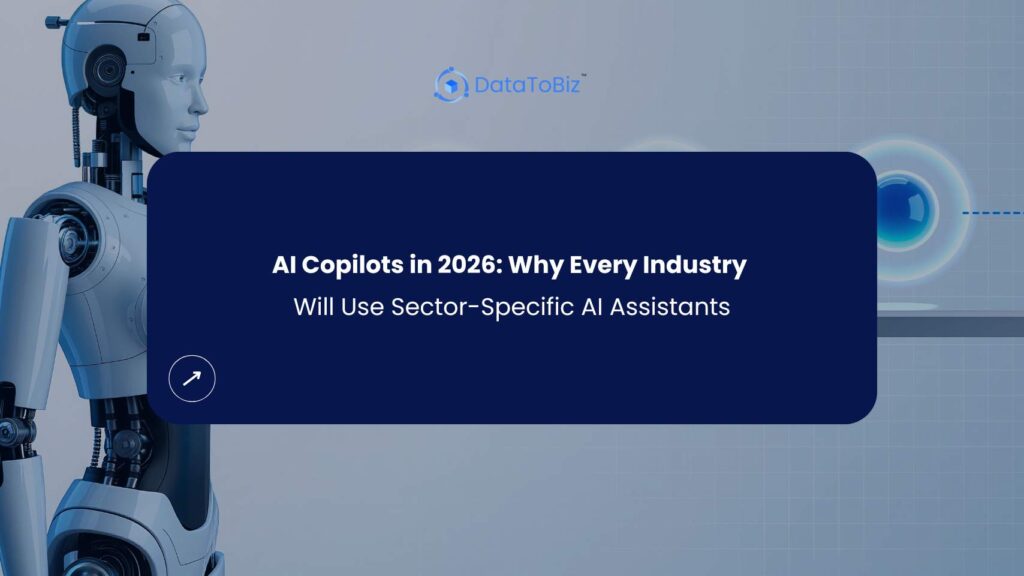
By 2026, AI copilots will be a standard across businesses. The ones that adopt them early will set new benchmarks for productivity, innovation, and customer experience. Those who delay may fall behind in competitive markets. These intelligent, autonomous assistants are not just a trend; they are a major shift in how organizations function and grow.
“Right now, people talk about being an AI company. There was a time after the iPhone App Store launch when people talked about being a mobile company. But no software company says they’re a mobile company now because it’d be unthinkable to not have a mobile app. And it’ll be unthinkable not to have intelligence integrated into every product and service. It’ll just be an expected, obvious thing.”, says Sam Altman, co-founder and CEO, OpenAI
This shift is already happening. 78% organizations are using AI, and 85% have implemented AI agents (copilots) in their business workflow. Businesses are increasing agentic AI adoption to improve their operations, and by 2026, almost every industry, such as IT, telecom, healthcare, and finance, will be using it.
“The playing field is poised to become a lot more competitive, and businesses that don’t deploy AI and data to help them innovate in everything they do will be at a disadvantage.” Paul Daugherty, Chief technology and innovation officer, Accenture Industries are prioritizing this shift for reasons such as personalization, speed, efficiency, data-driven insights, and scalability. In this blog, we’ll explore why AI copilots are becoming essential across industries and how agentic AI adoption is reshaping the way businesses operate.
What is an AI Copilot?
An AI copilot is a smart software assistant that helps you with tasks, decisions, and workflows. It uses artificial intelligence to automate repetitive work, provide insights from data, and suggest solutions, so you can focus on higher-value tasks. Over time, it learns from your actions, making its support more personalized and effective.
Key Features of Enterprise AI Copilot
Below, we’ve described key features of AI Copilots:
- Decision support: Helps make faster, smarter, and more informed business decisions.
- Task automation: Handles repetitive or routine work, freeing up time for employees.
- Intelligent suggestions: Provides recommendations and insights based on data and context.
- Learning & adaptation: Learns from user actions and improves its assistance over time.
- Data analysis: Processes large amounts of information quickly to identify patterns and trends.
- Personalization: Tailors outputs and suggestions to individual workflows or industry-specific needs.
- Collaboration support: Assists teams by streamlining communication, scheduling, and workflow management.
- Error reduction: Minimizes mistakes by providing consistent, accurate guidance.
- Integration with tools: Works seamlessly with existing software, apps, and systems.
- Scalability: Handle increasing workloads without additional human resources.
How Do AI Copilots Work?
AI copilots use AI to understand tasks, analyze data, and provide assistance in real time. They combine machine learning and natural language processing to offer suggestions, automate tasks, and help make smarter decisions.
When you interact with an AI copilot, it learns from your behavior, preferences, and past actions and then improves its recommendations. It also integrates with existing software and systems, allowing it to streamline workflows, reduce errors, and enhance productivity.
Why Are Industries Adopting AI Copilots?
Industries are rapidly adopting industry-specific AI copilots because they offer tangible benefits that transform the way businesses operate. Here’s how:
- Efficiency and productivity: Vertical AI copilots automate routine processes like data entry, scheduling, and reporting. This reduces manual effort, speeding up AI workflow automation and allowing teams to achieve more in less time.
- Smarter decision-making: By analyzing real-time data and spotting patterns humans might miss, AI copilots help businesses make faster and more informed decisions. This is extremely helpful in industries like finance, healthcare, and IT, where precision is important.
- Enhanced customer experience: AI copilots provide personalized recommendations, respond to customer queries instantly to offer exceptional customer service in sectors like retail, telecom, and banking.
- Error reduction and consistency: By handling repetitive tasks accurately, AI copilots minimize human errors and maintain consistent quality across processes, demonstrating the importance of industry AI automation.
- Scalability: As businesses grow, you can easily scale AI assistant enterprise solutions without increasing the workforce, making them ideal for fast-growing companies.
Industry-specific Examples of Usage of AI Copilots
Below, we’ve discussed a few industry-specific examples of AI copilot use cases:
Healthcare
AI copilots in healthcare are already making a difference by helping doctors and nurses work more accurately and quickly. For example, Penda Health’s AI clinical copilot, which is built into their electronic health records, supported doctors during 40,000 patient visits. It helped reduce diagnostic mistakes by 16% and treatment errors by 13%. The copilot gives real-time alerts and suggestions based on local medical guidelines.
Finance
In the finance industry, AI copilots automate routine analysis and detect anomalies in transactions. This improves speed and accuracy in compliance and fraud detection. Financial organizations are deploying copilots for real-time data analysis to inform investment decisions and manage risks.
IT and software development
AI copilots are widely used to help with tasks like writing code, finding bugs, and handling routine DevOps work. Tools like GitHub Copilot provide developers with real-time code suggestions and automate testing, which helps them to work faster and make fewer mistakes. This leads to quicker product releases and better software quality.
Retail
AI copilots help retailers to personalize customer experiences by recommending products based on browsing and purchase history. They also automate inventory management and route logistics. For example, Zalando, a German eCommerce brand retailer, uses a ChatGPT-powered virtual assistant that helps customers with product information and choose products.
The assistant recommends outfit ideas tailored to the season, occasion, and personal preferences, offering a personalized shopping experience.
How Businesses Must Prepare for Implementing Generative AI for Enterprise Workflows?
Implementing Generative AI in enterprise workflows is a strategic decision and needs careful planning and a structured approach. It’s about identifying how AI can enhance efficiency and improve accuracy. A well-planned implementation ensures that AI solutions align with business needs and deliver measurable value.
Seek AI consulting services for tailored solutions
Every organization has its workflows, data structures, and business objectives. Partnering with an AI development company ensures a customized approach towards implementation. Gen AI technology consultants help you identify where generative AI fits best, without creating friction with existing systems.
- Work with industry experts who understand your business challenges and objectives.
- Map existing workflows to find where generative AI can offer value.
- Ensure seamless integration with current tools and software systems.
- Define clear goals and success metrics before implementation.
Start with pilot projects
Always start with a phased approach that allows you to test assumptions and gather insights to refine your strategy. Pilot projects reduce risk and build confidence among employees. It’s better to start with a specific problem that AI can solve rather than doing a company-wide rollout.
- Choose a limited-scope project with clear, measurable outcomes.
- Run tests to assess AI accuracy, speed, and user interactions.
- Use feedback to improve workflows before scaling to other areas.
- Expand gradually while monitoring results and employee feedback.
Measure ROI and refine processes
Ongoing evaluation ensures that AI investments are delivering the expected results. Define performance indicators that matter to your business and continuously track progress. Further, you can make adjustments based on data-driven insights that allow you to refine models and optimize processes.
- Set KPIs such as cost efficiency and customer satisfaction.
- Collect data during both pilot and scale phases to evaluate effectiveness.
- Regularly update AI models and workflows based on usage.
- Align improvements with long-term business objectives.
Encourage workforce adoption and upskilling
The best AI solutions fail if employees are not comfortable using them. Training and support play a vital role in ensuring that teams understand the value AI brings and how it helps them. Encouraging employees to use AI through clear communication and continuous learning helps integrate AI into daily operations seamlessly.
- Offer training sessions tailored to different teams and roles.
- Provide resources and documentation to guide users through workflows.
- Create support channels to help employees troubleshoot issues quickly.
- Foster a culture that embraces AI as a tool for enhancement, not replacement.
Conclusion
AI copilots will become strategic partners in all industries. Companies that use them to optimize operations and enhance decision-making will unlock new revenue opportunities. Availing AI consulting services allows organizations to implement solutions that fit their unique workflows, while ongoing AI integration ensures continuous improvement and adaptability. Companies that adopt AI copilots early will work more efficiently and serve customers better, while those that wait may struggle
FAQs
Which departments benefit the most from adopting AI copilots first?
The departments that will benefit the most from adopting AI copilots include sales, marketing, customer support, and software development. These departments handle large volumes of repetitive tasks and can automate them to make data-driven decisions. For example, sales teams can use AI copilots for personalized outreach, analyzing leads, and forecasting trends. Marketing teams can automate content creation, campaign optimization, and audience segmentation.
What ROI can I expect from deploying an AI copilot in my organization?
Deploying an AI copilot like Microsoft 365 Copilot delivers a huge return on investment (ROI), particularly for small and medium-sized businesses. According to the Total Economic Impact™ (TEI) study by Forrester Consulting, businesses can get an ROI ranging from 132% to 353% over a three-year period. This means increased revenue, low operational costs, and high employee productivity.
Do AI copilots replace employees or enhance their productivity?
AI copilots enhance human productivity rather than replace employees. They automate repetitive and time-consuming tasks and free up employees to focus on creative and strategic tasks. They use contextual data to offer relevant help and perform tasks like creating documents, analyzing data, or suggesting code.
What challenges should I plan for when integrating AI copilots into workflows?
Some common challenges that you face when integrating AI copilots into workflows include:
- Employees may resist using AI copilots because they fear they could replace their jobs.
- Handling sensitive data with AI tools needs strict security protocols and compliance with privacy regulations.
- AI systems can reflect biases from the data they’re trained on, resulting in unfair decisions.
- Integrating AI with existing tools and legacy systems can be challenging and requires assistance from Gen AI technology consultants.
How do I choose the right AI copilot solution for my business needs?
To choose the right AI copilot for your business, follow the steps below:
- Identify the problems you want to solve with AI Copilot.
- Find solutions that integrate with the tools your teams already use
- Check if the AI can be customized to your workflows and industry needs.
- Evaluate data security and privacy standards to ensure the enterprise AI copilot meets compliance requirements.
- Test the copilot to see how it performs in real-world scenarios before scaling across the organization.
Fact checked by –
Akansha Rani ~ Content Management Executive