
During the initial discussions, the client shared a clear view of the challenges limiting the effectiveness of their data and AI initiatives. Solving these required coordinated support from Data Engineers, AI and ML Engineers, Cloud Engineers, and Visualization Experts.
To address these challenges, our team at DataToBiz implemented a future-ready MLOps platform on Microsoft Azure, bringing together AI and ML engineers, data engineers, cloud architects, and visualization specialists.
Cloud and data foundation
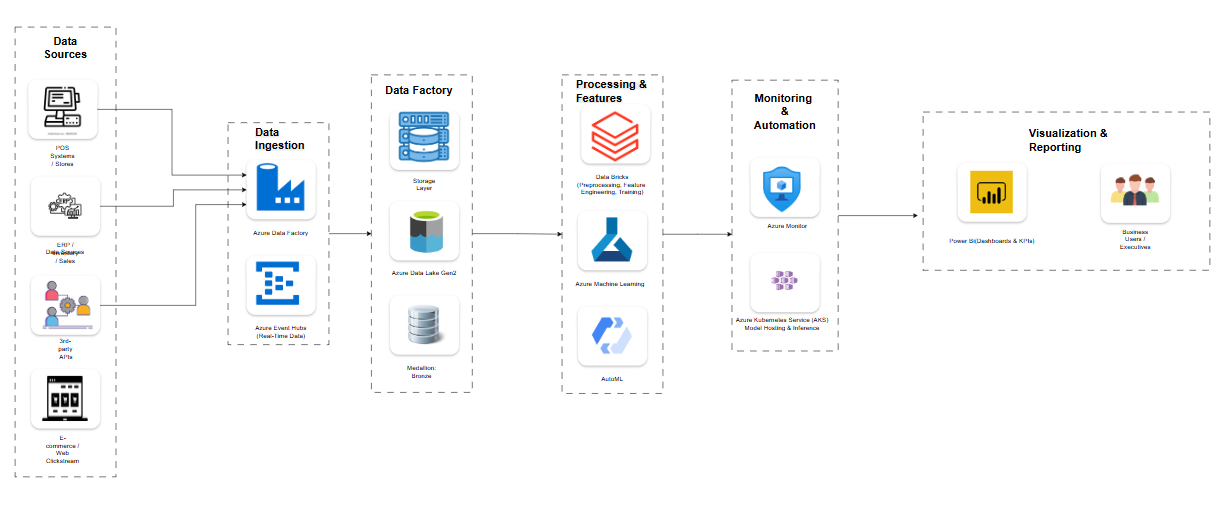
Built on Azure for scalability and security, with data ingestion through Azure Data Factory and Event Hubs. Data was stored and governed in Azure Data Lake Gen2 using a layered architecture for quality and traceability.
Model development and deployment
Databricks supported data preparation and model training, while Azure Machine Learning handled AutoML, tuning, and CI/CD. Models were deployed as containers on Azure Kubernetes Service for scalable inference.
Monitoring and lifecycle management
Azure Monitor and Application Insights tracked performance, drift, and system health, with automated alerts and retraining triggers to maintain reliability.
AI and NLP capabilities
Transformer-based models were fine-tuned for dynamic pricing, sentiment analysis, and customer segmentation use cases.
Visualization and access control
Power BI dashboards delivered real-time KPIs, with role-based access ensuring secure and structured visibility across teams.
More accurate models
Automated retraining kept models aligned with fresh data, improving demand forecasting and pricing accuracy by around 20-25% across key retail use cases.
Faster launches
Standardized MLOps pipelines reduced model deployment cycles from several weeks to just a few days, helping teams respond faster to market changes.
AI at global scale
The platform supported consistent and compliant AI operations across 15+ countries, allowing teams to deploy and manage models centrally without regional fragmentation.
Stronger governance and security
Role-based access controls and centralized monitoring improved data security and oversight, significantly reducing compliance risks across teams.
Real-time decision support
Live dashboards delivered near real-time insights into pricing, demand, and customer behavior, enabling leaders to act with speed and confidence.
Improved operational efficiency
Automation across data, training, and deployment workflows reduced manual effort by nearly 30%, lowering operational costs and minimizing human error.
This engagement helped the client bring structure and speed to how AI is built and used across the organization. With a scalable MLOps setup in place, teams can now launch models faster, trust their insights, and make better decisions in real time as the business grows.
Retail & E-commerce
US
Staff/Resource Augmentation
Briefly describe the challenges you’re facing, and we’ll offer relevant insights, resources, or a quote.

Business Development Head
Discussing Tailored Business Solutions

DataToBiz is a Data Science, AI, and BI Consulting Firm that helps Startups, SMBs and Enterprises achieve their future vision of sustainable growth.
DataToBiz is a Data Science, AI, and BI Consulting Firm that helps Startups, SMBs and Enterprises achieve their future vision of sustainable growth.