
Don't Scale on a Weak Foundation

Azure Data Platform-Led BI Modernization in Professional Services Firm

About Client

  • A  large professional services organization in India, operating across multiple business functions, including Finance, Sales, HR, CRM, Marketing, Project Management, and Customer Operations.
  • With a huge client base, they are known for supporting and uplifting cross-departmental workflows.

Problem STATEMENT

The organization was facing several challenges in managing and using data effectively due to fragmentation across applications and file-based workflows. These limitations slowed reporting cycles, introduced inconsistencies, and made it difficult to deliver timely, reliable insights for decision-making.

  • No single version of insights
    Data was spread across SAP, Salesforce, HRMS, mobile applications, and offline spreadsheets, leading to mismatches and inconsistent reporting.
  • Manual, error-prone processes
    Teams relied heavily on Excel files and email-based data sharing, which increased manual effort, delays, and the risk of errors.
  • Inconsistent reporting standards:
    Different departments used their own formats and definitions, reducing trust in reports and making cross-functional analysis difficult.
  • Limited automation:
    There were no automated pipelines for data refresh, validation, or reconciliation, requiring repeated manual intervention.
  • Delayed insights:
    Leadership often worked with outdated or incomplete reports, limiting the ability to make timely, data-informed decisions.

Solution

To address these challenges, our team of data engineers and BI developers worked with the client through a phase-wise implementation approach, focused on consolidation, standardization, and automation. The goal was to simplify the reporting lifecycle while creating a reliable, scalable data foundation for a large professional services organization.

  • In the initial phase, we designed and implemented an Azure-based centralized data platform to bring together data from more than ten enterprise and operational systems. This established a single, governed data layer that all departments could rely on.
  • As the platform evolved, our engineers built automated system-to-lake pipelines, enabling regular, validated data ingestion with minimal manual intervention. Standardized enterprise data models and unified KPIs were then introduced to ensure consistency across Finance, Sales, HR, CRM, and Operations.
  • In parallel, our BI developers focused on usability. Using Figma-led design, we created over 60 role-based Power BI dashboards, tailored to different business functions and decision levels. These dashboards supported both real-time and scheduled refreshes, ensuring stakeholders always had access to current data.
  • The final phase focused on sustainability. Documentation, governance frameworks, and end-user training were put in place to help teams adopt the platform confidently and maintain it over time.

Technical Implementation

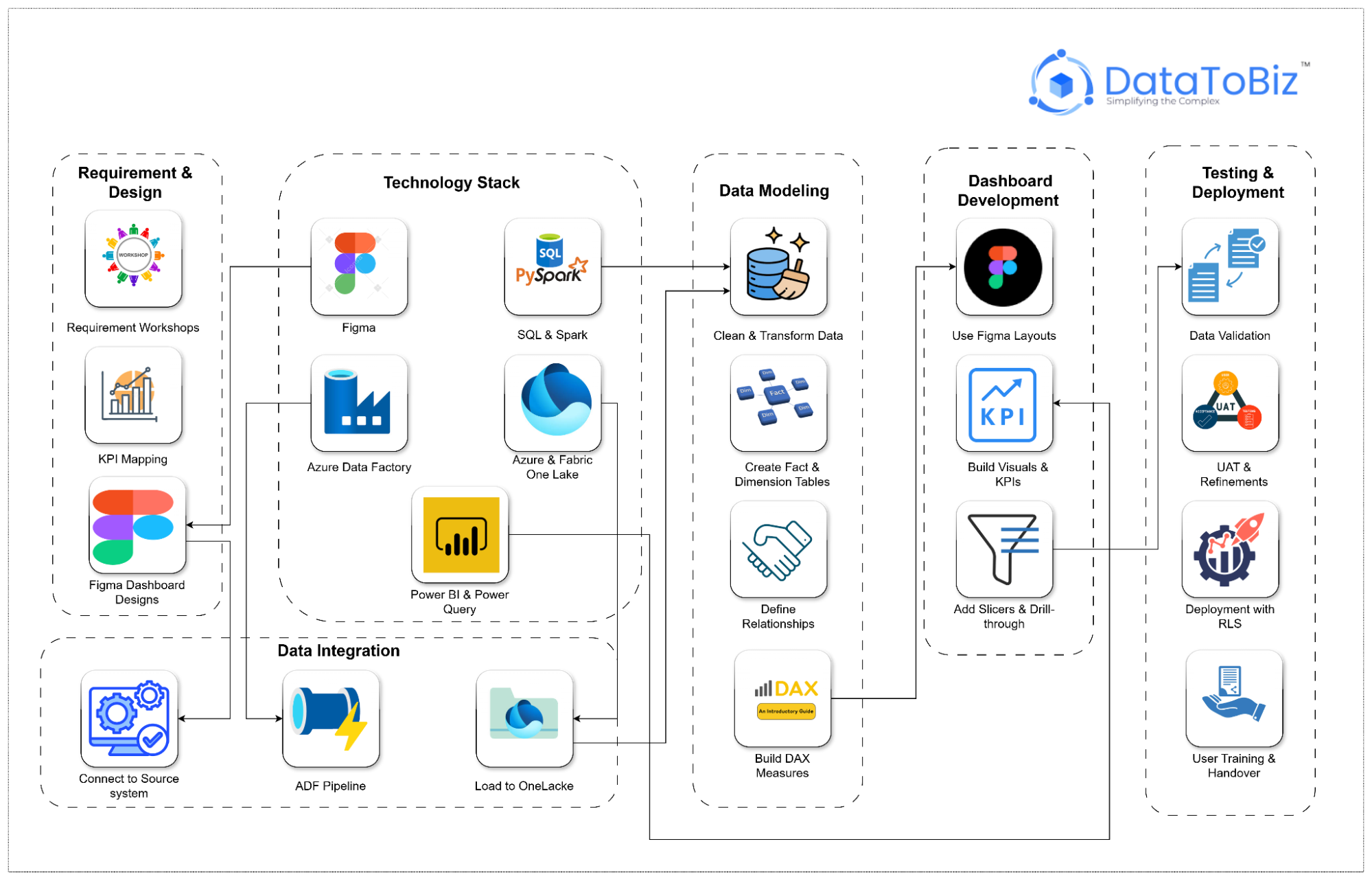
The implementation leveraged a modern Microsoft data and analytics stack, enabling seamless data ingestion, transformation, modeling, automation, and the creation of intuitive, business-aligned dashboards.

Requirement & Dashboard Design

  • Requirement workshops and KPI mapping across departments
  • Figma wireframes and UX layouts designed and reviewed
  • Stakeholder sign-off on dashboard structure and KPIs

Data Ingestion & Preparation

  • Data ingested from SAP, Salesforce CRM, Marketing Cloud, SuccessFactors, Asite, Reloy, websites, email systems, and offline files
  • Data cleaning, validation, and transformation using Power Query, SQL, and Spark
  • Curated datasets organized in Azure OneLake for consistency and reuse

Data Modeling & KPI Logic

  • Fact and dimension table design for enterprise reporting
  • Relationship mapping and standardized KPI logic
  • DAX measures and calculated fields implemented for analytics

Dashboard Development

  • 60 Power BI dashboards developed as per Figma designs
  • Drill-throughs, slicers, cross-filtering, and interactivity enabled
  • Standardized themes applied across all dashboards

Testing, UAT & Deployment

  • KPI validation, data accuracy, and performance testing
  • UAT with business teams and iterative refinements
  • Deployment with role-based access and documentation

Training & Handover

  • End-user training and knowledge transfer sessions
  • Delivery of data dictionaries, architecture documents, and usage guides

Technical Architecture

Azure Data Platform-Led BI Framework

Business Impact

Faster reporting cycles
Automated data pipelines and centralized reporting reduced manual reporting effort by nearly 85%, enabling teams to access insights in minutes instead of days.

More accurate and reliable data
Standardized KPIs and unified data models improved overall data accuracy by almost 90%, giving stakeholders greater confidence in reports and metrics.

Quicker decision-making
With automated refreshes and real-time dashboards, reporting cycles became 75% faster, helping leadership make decisions about 60% quicker than before.

Elimination of version conflicts
A single centralized platform removed Excel-based version control issues entirely, achieving 100% consistency across reports and departments.

Stronger cross-team visibility
Unified dashboards across business functions increased cross-department visibility and collaboration by around 50%, breaking down data silos.

Reduced reliance on offline reporting
With reliable Power BI dashboards in place, dependency on offline Excel files dropped by nearly 40%, improving governance and control.

With the centralized Azure data platform and modern Power BI ecosystem in place, these outcomes enabled the organization to operate with a trusted single data source while laying a solid foundation for future analytics, automation, and AI initiatives.

Related Case Studies

Drop Your Business Concern

Briefly describe the challenges you’re facing, and we’ll offer relevant insights, resources, or a quote.

Ankush

Business Development Head
Discussing Tailored Business Solutions

DMCA.com Protection Status