Don't Scale on a Weak Foundation

Microsoft Power Platform Copilot Deployment for a Leading Australian Telecom Hub

About Client

  • The client is a leading telecommunications provider headquartered in Australia, delivering connectivity, broadband, and enterprise communication services across the region.

Problem STATEMENT

The client’s legacy systems and manual development processes created bottlenecks, limiting innovation and responsiveness.

  • Dependence on IT Teams: Slow development cycles for simple automation needs.
  • Siloed Systems: Data scattered across ERP, CRM, and HR systems, restricting insights.
  • Limited Citizen Development: Non-technical staff lacked tools to build internal apps.
  • Manual Processes: Routine tasks like reporting, scheduling, and approvals handled manually.
  • Scalability & Governance Issues: No unified framework for app governance or compliance.

These challenges reduced operational agility and hindered digital transformation across departments.

Solution

DataToBiz implemented an AI-driven, low-code development framework built on Microsoft Power Platform Copilot and Azure Cloud Services.

  • AI-Assisted App Creation: Employees used Copilot prompts to design apps and forms with minimal coding.
  • Azure Data Integration: Centralized all business data in Azure Data Lake and Dataverse.
  • Workflow Automation: Deployed Power Automate to streamline notifications, reporting, and approval workflows.
  • AI-Powered Analytics: Integrated Power BI Copilot for natural language queries and automated insights.
  • Citizen Developer Enablement: Created Center of Excellence (CoE) governance model for citizen development.
  • Secure Deployment: Aligned environments with Azure Active Directory for identity management and data compliance.

The solution enabled faster innovation, self-service development, and AI-assisted decision-making across the organization.

Technical Implementation

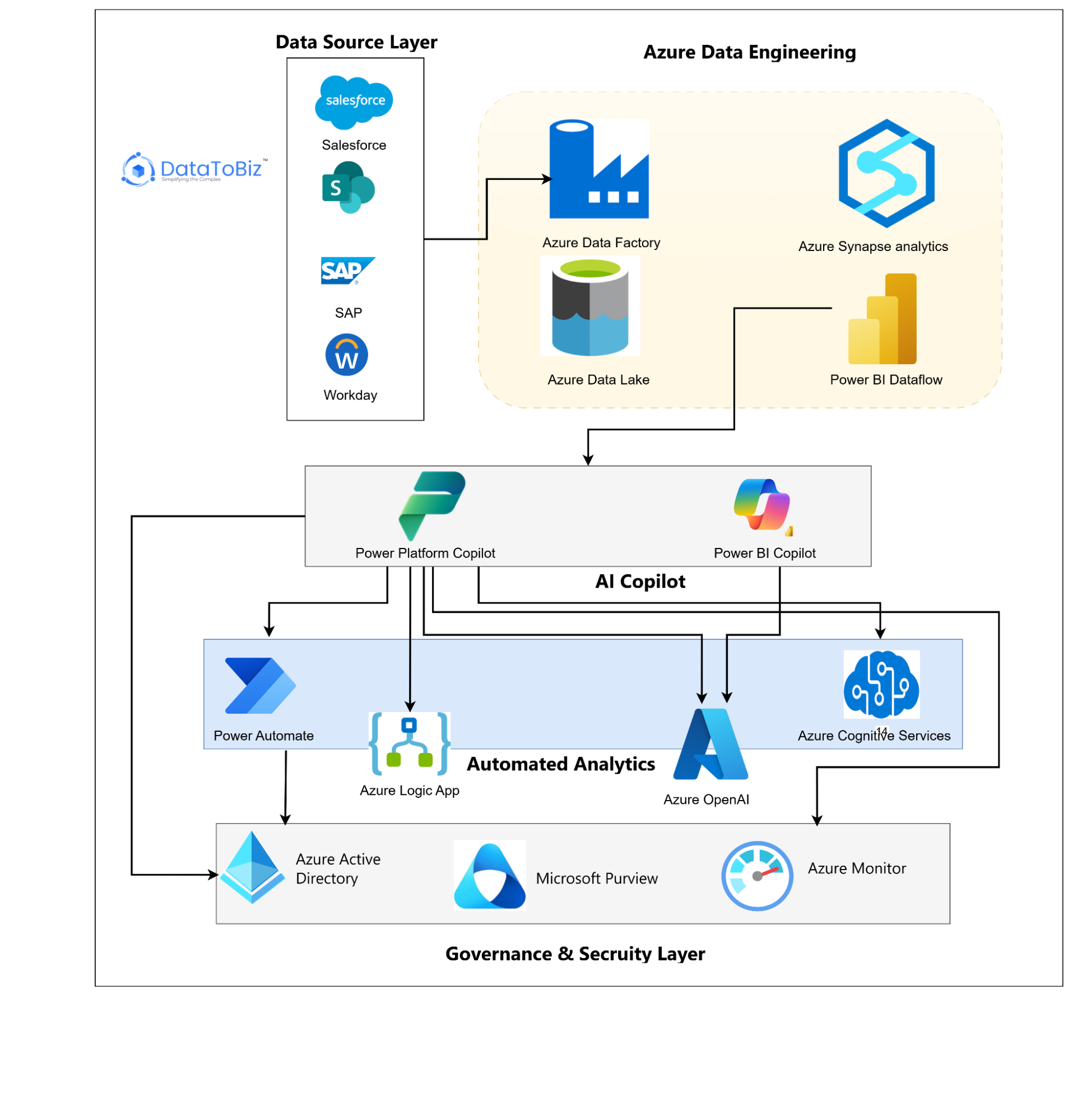
The implementation brought together Azure Data Engineering and Microsoft AI Copilot capabilities to unify data from multiple enterprise systems including ERP, CRM, HRMS, SharePoint, and various operational databases. This integration created a single, intelligent foundation for automation, analytics, and low-code development.

Technical Highlights:

  • Data Ingestion & Integration:
    • Built Azure Data Factory pipelines to extract data from Salesforce (CRM), SAP (ERP), Workday (HRMS), and SharePoint Online.
    • Standardized and consolidated datasets into Azure Data Lake, enabling unified access for both IT and business teams.
  • Data Modeling & Transformation:
    • Utilized Azure Synapse Analytics for transformation, modeling, and joining multi-source data for downstream consumption.
    • Implemented Power BI Dataflows to simplify data refresh and transformation for citizen developers.
  • AI Copilot Integration:
    • Enabled Power Platform Copilot to guide app creation, report building, and workflow design using natural language prompts.
    • Connected Power BI Copilot to Azure Data Lake for conversational insights and automated dashboard generation.
  • Automation Layer:
    • Developed Power Automate workflows linked to Microsoft Teams and Dynamics 365 for approvals, alerts, and task scheduling.
    • Integrated Azure Logic Apps for backend system triggers and advanced orchestration.
  • AI & Analytics Layer:
    • Embedded Azure OpenAI for predictive text generation, insights summarization, and anomaly detection.
    • Leveraged Azure Cognitive Services for sentiment analysis and form recognition within internal workflows.
  • Governance & Security:
    • Applied Microsoft Purview for data lineage tracking and compliance monitoring.
    • Enforced role-based access controls (RBAC) via Azure Active Directory, ensuring secure data and app usage.
    • Implemented Azure Monitor and Log Analytics for ongoing system performance visibility.

This architecture enabled seamless data flow, governed low-code app development, and AI-driven insights, allowing both IT and business teams to collaborate effectively while maintaining compliance and scalability.
Technical Architecture

MICROSOFT POWER

Business Impact

  • 60% faster application development through AI-assisted low-code automation.
  • 40% reduction in dependency on centralized IT for business process needs.
  • 70% improvement in reporting efficiency with Power BI Copilot dashboards.
  • 100+ micro-apps developed by citizen developers within six months.
  • Enhanced governance & compliance through centralized monitoring and RBAC policies.
  • Improved employee engagement, fostering a culture of innovation and ownership.

Overall, the initiative created a data-driven, self-sufficient workforce capable of rapid solution development and automation. The Australian telecom enterprise successfully transformed its application development and data operations by implementing Microsoft Power Platform Copilot integrated with Azure Data Engineering and AI Copilot technologies.

Drop Your Business Concern

Briefly describe the challenges you’re facing, and we’ll offer relevant insights, resources, or a quote.

Ankush

Business Development Head
Discussing Tailored Business Solutions

DMCA.com Protection Status