
To move its digital transformation from plans to real progress, the company needed experienced data and AI specialists who could work alongside internal teams and speed up delivery across manufacturing analytics initiatives. As production scaled and operations grew more complex, a few roadblocks became clear:
Disconnected Systems All Around
Production, supply chain, quality, and finance data lived in separate ERP, MES, and legacy systems, making it difficult to get a single, reliable view of operations.
Limited Live Visibility
Without live dashboards, leadership teams had to wait for updates on production performance, downtime, and inventory levels, slowing decision-making on the shop floor.
Manual, Time-Consuming Reporting
Teams were spending hours consolidating data manually, increasing the risk of errors and delaying critical business reviews.
Reactive Planning Instead of Predictive Forecasting
Demand planning and production forecasts relied heavily on historical data, with little predictive intelligence to anticipate shifts in demand or supply disruptions.
Hidden Bottlenecks and Quality Risks
The absence of proactive monitoring made it difficult to identify process bottlenecks, quality deviations, and potential equipment failures before they impacted output.
Data Infrastructure Under Pressure
As data volumes grew, the existing infrastructure struggled to scale, limiting the organization’s ability to adopt advanced analytics and AI-driven insights.
Through a staff augmentation model, DataToBiz embedded skilled AI and analytics professionals within the client’s teams to modernize the manufacturing data ecosystem and strengthen internal capabilities.
Unified Data Platform:
Our team worked alongside internal IT and operations teams to centralize data from ERP, MES, supply chain, quality, and IoT systems into a single analytics-ready platform. We designed structured data models and standardized schemas so different departments could work from the same, consistent data foundation.
Automated Data Engineering:
Dedicated data engineers built and managed scalable ETL pipelines to automate data extraction, transformation, and loading. This ensured clean, validated, and timely datasets were always available for reporting and advanced analysis, while reducing manual intervention.
BI & Reporting:
Power BI developers created interactive dashboards and KPI reports focused on production output, downtime tracking, inventory movement, and quality metrics. These dashboards were aligned with operational goals and designed for plant managers, operations heads, and leadership teams.
AI-Powered Analytics:
Data scientists developed predictive models to improve demand forecasting, optimize production schedules, and detect anomalies in equipment and process data. This added a forward-looking layer to existing reporting systems.
Secure & Scalable Architecture:
Architects and governance specialists implemented role-based access controls, data security policies, and modular architecture principles. This ensured compliance, protected sensitive operational data, and allowed the platform to scale as data volumes and analytics needs increased.
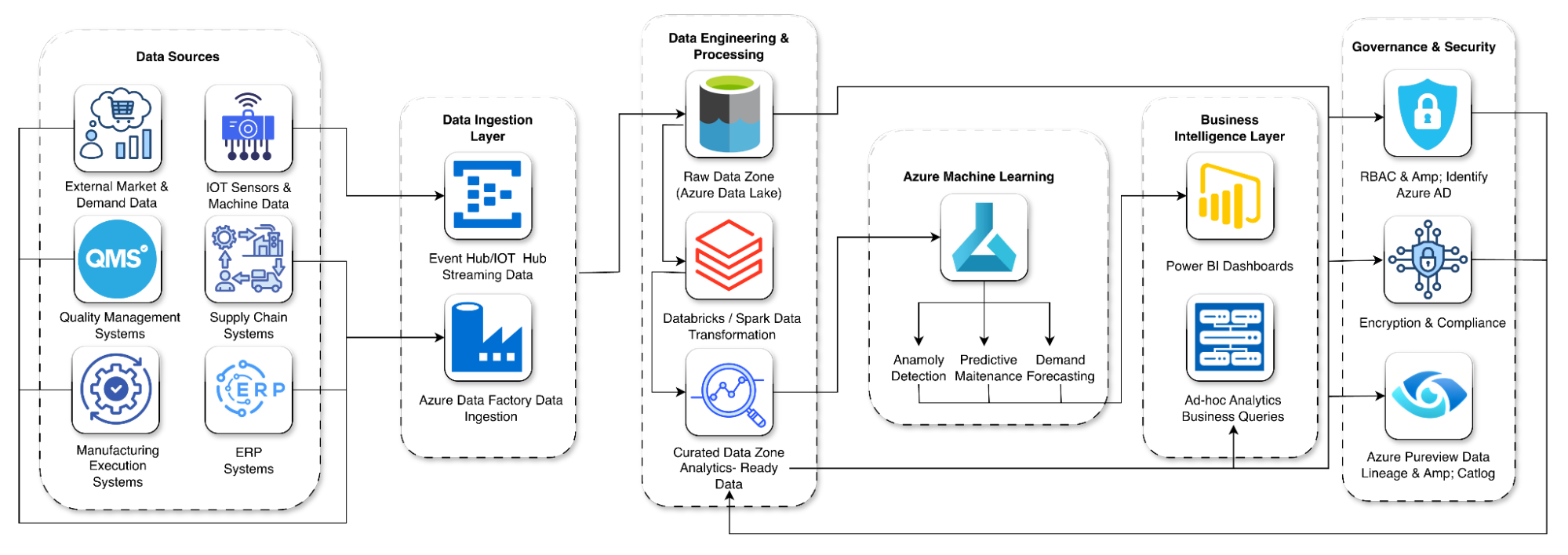
The augmented team worked within the client’s existing technology environment to build and manage a modern, cloud-based data and analytics stack:
Data Sources:
Data was integrated from ERP systems, MES platforms, IoT sensors, supply chain applications, quality management systems, and selected external market data sources.
Data Engineering Layer:
Our engineers used Azure Data Factory and Databricks to design and manage ETL pipelines. These pipelines handled data extraction, transformation, validation, and quality checks at scale.
Centralized Data Storage:
Azure Data Lake was set up as the central storage layer, organizing raw, processed, and curated data to support both batch and near real-time analytics use cases.
Analytics & BI Layer:
Power BI dashboards delivered insights into production efficiency, downtime patterns, inventory levels, and quality trends, combining both historical and current data views.
AI & Machine Learning:
Azure Machine Learning was used to build and deploy models for demand forecasting, predictive maintenance, anomaly detection, and root cause analysis.
Automation & Orchestration:
Scheduled workflows and event-based triggers were implemented to automate data refreshes, model retraining, and report updates.
Governance & Security:
Azure Purview, role-based access controls, and encryption policies were applied to ensure data lineage, auditing, and compliance with internal governance standards and industry regulations.
Faster Reporting Cycles
Automated data pipelines reduced manual reporting effort by 45%, freeing up teams from repetitive data consolidation and lowering reporting errors.
Reduced Unplanned Downtime
AI-driven forecasting and anomaly detection helped cut unplanned downtime by 25%, improving production stability and output consistency.
Improved Decision Speed
With embedded BI and analytics support, operational and strategic decisions were made 30% faster across plants.
Optimized Inventory Levels
Better demand visibility and forecasting reduced excess inventory by 20%, improving working capital efficiency.
Scalable Analytics Capability
The cloud-based data platform scaled quickly to handle growing data volumes and new use cases without adding permanent hiring overhead.
Faster Talent Onboarding
Specialized cloud and analytics professionals were onboarded within 3,4 weeks, compared to the typical 3 to 5 months required for traditional hiring.
Flexible Delivery Model
Resources were aligned with plant-level rollout schedules and production cycles, ensuring smooth implementation without disrupting operations.
Operational-Grade Quality
Governed dashboards, validated data pipelines, and production-ready predictive models supported continuous 24×7 plant operations.
Knowledge Transfer to Internal Teams
By the end of the engagement, internal teams independently managed over 70% of reporting and analytics workflows.
Repeatable Analytics Framework
A structured delivery approach was established, creating a reusable model for future factory modernization and digital transformation initiatives.
For the manufacturer, this was not just about adding dashboards or deploying models. It was about building a data backbone that plants could rely on every day.
By combining internal expertise with our augmented AI and analytics team, they moved from scattered systems and manual reporting to a connected, scalable data environment. Production teams gained clarity. Leadership gained speed. And internal teams gained the confidence to manage and expand the platform on their own.
Manufacturing & Industrial Engineering
UK
Staff/Resource Augmentation
Briefly describe the challenges you’re facing, and we’ll offer relevant insights, resources, or a quote.

Business Development Head
Discussing Tailored Business Solutions

DataToBiz is a Data Science, AI, and BI Consulting Firm that helps Startups, SMBs and Enterprises achieve their future vision of sustainable growth.
DataToBiz is a Data Science, AI, and BI Consulting Firm that helps Startups, SMBs and Enterprises achieve their future vision of sustainable growth.