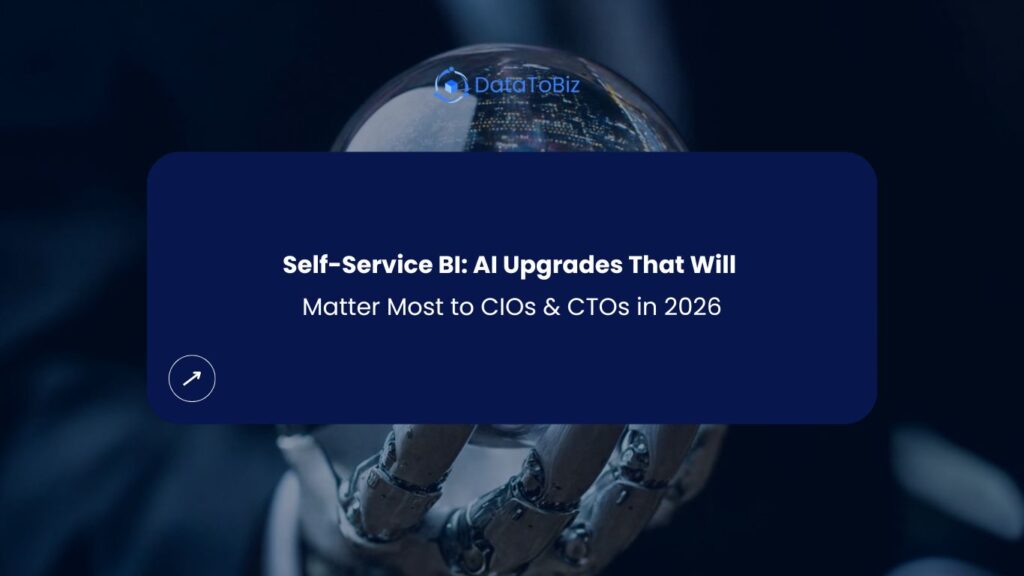
Self-service business intelligence is a solution for non-technical employees to access data visualization and make data-driven decisions. Here, we’ll discuss the coolest AI upgrades that will matter most to C-suites as they transform Self-Service BI into a more powerful, enterprise-ready capability.
Business intelligence (BI) is a collection of processes and technologies that convert the collected data into actionable insights. It includes data collection, data analytics, data transformation, and data visualization to unlock the true potential of business data for proactive decision-making. Business intelligence is a technical process handled by experts with the required domain expertise.
So, how do non-technical users and other employees use BI? This is possible through self-service business intelligence, a set of processes and tools that can be used by employees from non-IT backgrounds to derive meaningful insights. There has been an increase in demand for self-service BI in recent years. According to The Business Research Company, the self-service BI market is expected to reach $11.84 billion in 2025, with an estimated CAGR (compound annual growth rate) of 17.3% to touch $22.42 billion by 2029.
Self-service BI tools are user-friendly, mobile-responsive, and effective. You can select from the existing options in the market or build a customized self-service BI tool with enhanced AI capabilities for a better user experience. In fact, several organizations are transforming their self-service BI systems by partnering with a reliable AI consulting company. This gives your business a competitive edge and increases employee efficiency and performance.
In this blog, let’s look at some of the coolest AI features to incorporate into your establishment’s self-service BI.
Role of AI in Self-Service BI
Self-service BI can be implemented in two ways: one is a simple process with pre-built reporting templates, and the other is a comprehensive platform with AI capabilities. Many businesses have been using both, starting with simple solutions and scaling to include more advanced features, but without complicating it too much. Using AI in self-service BI allows employees to work with complex databases and functionalities if they want to.
Not every business can afford to have an in-house team of data analysts or BI experts. They may not want to hire third-party or offshore providers unless necessary for a big project. That doesn’t mean the business has to ignore analytics. It can still empower employees by providing tools for self-service BI. Sending queries, generating reports, and working with interactive data visualization dashboards don’t require high technical expertise.
With AI-powered self-service analytics, your employees can do all these without any programming or coding knowledge. Basic training to use the interface is sufficient. This accelerates the decision-making process as valuable insights will always be available at employees’ fingertips. You can hire business intelligence consulting services to establish the initial architecture and connections for a streamlined data flow. Once it is ready, employees can access and utilize the insights for their daily activities.
Coolest AI Features Transforming Self-Service BI in 2026
AI features transforming BI for self-service is not just an interesting idea or theory. It is being implemented by various enterprises to enhance the business intelligence tools and empower employees to derive insights in real-time without depending on IT teams.
Automated Insights
AI automation in self-service BI is one of the most popular and coolest features to incorporate into the tool. Instead of manually performing the analytics, employees can use artificial intelligence-based features to automate the process. In this, the backend steps are automated to share instant output with the users. So, the employee provides an input and gets a response in real-time or near-real-time without having to do anything much. The interactive dashboard can be customized to derive different types of analytics with a couple of clicks. Imagine not having to wait for another team to send the response to the query as the AI feature takes care of it.
AI-Driven Recommendations
AI agent development services allow the adoption of conversational AI in business intelligence for self-service. Non-technical users want simple systems. They want interfaces that converse with them. They want reports that can be straightforward to interpret. To ensure the self-service BI can give them that, you integrate the business intelligence tool with AI agents. That’s because the AI agent has a ‘memory’ of the previous conversations. They are trained to understand business logic and can provide recommendations that align with your organization’s vision, mission, and objectives.
Predictive Analytics and Recommendations
Predictive analytics for self-service BI is another cool functionality. It is a type of advanced analytics that analyzes historical data to identify hidden patterns and forecasts possible future outcomes. Predictive analytics is helpful in various ways – sales and market forecasting, risk management, identifying better opportunities, strategic planning, and so on. In fact, predictive analytics was considered the future of self-service BI due to the competitive edge it can offer to your organization. Moreover, the AI and NLP algorithms will be trained on your data to provide more in-depth and tailored insights. This increases accuracy and reliability.
Smart and Proactive Intelligence
Simply put, augmented analytics with AI refers to the process of integrating machine learning and NLP algorithms with data analytics and business intelligence platforms. This is done to streamline the workflows and democratize decision-making. The queries are provided as input in plain language used by humans instead of some complex code. The algorithm will understand the input and share the output by analyzing the datasets based on the query. By replacing SQL with the language we speak, AI transforms self-service BI into an everyday tool that can be used by most employees, irrespective of their technical knowledge and experience.
Building a Data Model with AI
Data is crucial for analytics as well as to train the AI and ML algorithms that power advanced features in business intelligence tools. A robust data model with a self-improvement cycle can strengthen the BI platform to deliver better quality insights as it learns from the input and feedback provided by the user. The AI product development company will build a data model that automatically collects and transforms data. It creates a predetermined set of questions or queries that the users can ask. As employees provide different questions as input, the algorithm learns and adds these questions to its existing list. Over time, it becomes highly efficient and attuned to knowing what employees want.
Prompt Chaining and Query Generation
Natural language query in BI tools is possible with generative AI integration. Furthermore, you can create a prompt chain with a series of questions/ queries to generate complex reports with in-depth details. By connecting a set of individual yet relevant queries, the AI algorithm can create a narrative to tell a story. This enhances the self-service BI tool to be more than just an analytics provider. The algorithms also learn user preferences, the writing style, the types of queries, etc., to tailor the responses accordingly. The narratives generated can also be used to create compelling presentations for high-level meetings and discussions.
Greater Dashboard Personalization
The dashboard is the interface where employees provide input and read the graphical reports. Typically, data visualizations are used to convert complex reports into user-friendly presentations through bar charts, pie charts, heat maps, scatter plots, etc. Users can select the type of chart/ graph, the color scheme, the parameters, and other details to customize the reports. This doesn’t require any programming knowledge. Most such features are powered by AI and can be used through drag-and-drop capabilities.
Copilot and Gemini Integration
The integration of LLM and generative AI in business intelligence can offer several benefits to end users (aka employees). In fact, integrating powerful genAI chatbots like Copilot and Gemini with BI tools facilitates automated narratives, predictive analytics, natural language querying, and much more. While Copilot is great for Microsoft Teams and Azure cloud users, Gemini is suitable for smaller teams and Google Cloud users. Copilot is already available as a premium offering with Microsoft Power BI and Fabric. Many large enterprises like Nestlé, Walmart, etc., are already using it.
Sharing and Collaboration
AI features can transform self-service BI tools into collaborative platforms where employees can work with BI consultants and other teams to share insights and make data-driven decisions. Both internal and external stakeholders can be given restricted access to data and insights without compromising data security. The same interface can be used for interactions like comments, notes, alerts, etc., which can be tracked from start to finish. This allows all the required team members to access the reports whenever necessary and make informed decisions for day-to-day activities.
AI-Powered Storytelling
Embedded AI analytics platforms bridge the gap between employees and analytical insights. They make insights accessible even when you are on the go. Now, combine this with AI-powered storytelling capabilities. The result is a highly interactive and user-friendly system that summarizes reports, simplifies graphs, and explains ‘what’ the insight means. Instead of leaving the burden of interpretation on the employee, generative AI handles this process to tell the story in simple words. This automated storytelling saves time, reduces the risk of human error, and increases consistency.
Conclusion
BI will continue to grow beyond traditional reporting, making self-service BI more prominent in the days to come. In today’s competitive world, it is vital to have insights and visualization reports accessible in real-time and on multiple devices (like smartphones, tablets, etc.).
BI dashboards can be integrated with third-party systems for direct access to the insights. With support and guidance from a reputable business Intelligence consulting company, you can transform self-service BI into a decision intelligence platform that empowers your employees to be more effective at work and achieve the desired goals.
More in Business Intelligence Services Providers
Business intelligence services help enterprises transform raw data into meaningful insights for data-driven decision-making. This opens doors for new opportunities and gives a competitive edge. BI consultants also streamline the data architecture to ensure employees across all departments and verticals can access the insights and use them for day-to-day business activities. It results in greater employee performance, enhanced customer experience, and higher ROI.
Read more about how BI can boost your revenue, the implementation can be a cakewalk, or choose risk-free BI partnerships.
- Responsible AI Implementation: Ethical Considerations for 2026
- PoC vs MVP in AI – Your Guide to Strategic Project Launch
- Data Governance in Self-Service BI: Managing Risks Without Data Gatekeepers
- Power BI for Marketing: Top Consulting Firms & Agencies to Know
FAQs
Which AI features are making self-service BI easier for non-technical teams?
The following AI features can make self-service BI easier for non-technical teams:
- Natural language processing for understanding user input
- Predictive analytics for forecasting
- Automating insights and report generation
- Conversational and generational AI for communication/ collaboration, etc.
Talk to our experts at DataToBiz and share your requirements with us. We will tailor the self-service BI tool to meet your specific requirements.
Can AI in BI reduce my reliance on IT or data engineering teams?
Using AI features in BI changes how your IT and data engineering teams work. The idea is not to reduce your reliance on them but to limit the interactions through automation, free up resources through optimization, and lower barriers to data access. Your data engineering teams will still have to work on data pipelines and architecture to keep everything running smoothly in the backend.
What kind of ROI can I expect from adopting AI features in self-service BI?
The actual ROI from adopting AI features in self-service BI varies from one organization to another and depends on factors such as the extent of usage, complexity, etc. By adding AI features to self-service BI, you can increase overall productivity, improve revenue streams, optimize resources and costs, and make faster and informed decisions. Schedule a meeting with experts at DataToBiz to transform your self-service BI with AI features.
Which industries benefit most from AI-driven self-service BI?
Many industries benefit from using AI-driven self-service BI tools. A few of them are listed below:
- Healthcare
- Marketing
- Logistics and Supply chain
- Retail and eCommerce
- Finance, etc.
Businesses from most industries find it advantageous to use AI-driven self-service BI. At DataToBiz, we understand your needs and provide tailored, robust solutions to help you achieve your goals.
How do I choose the right AI-enabled BI platform for my business?
Consider the following factors when choosing an AI-enabled platform for your business:
- Advanced analytics
- Ease of use
- End-to-end data management
- Dynamic and interactive dashboards
- Customization
- Scalability
- Third-party integrations
At DataToBiz, we will help you make the right choice by comparing and aligning your requirements with the available tools. We also offer long-term support and maintenance services.
Fact checked by –
Akansha Rani ~ Content Management Executive