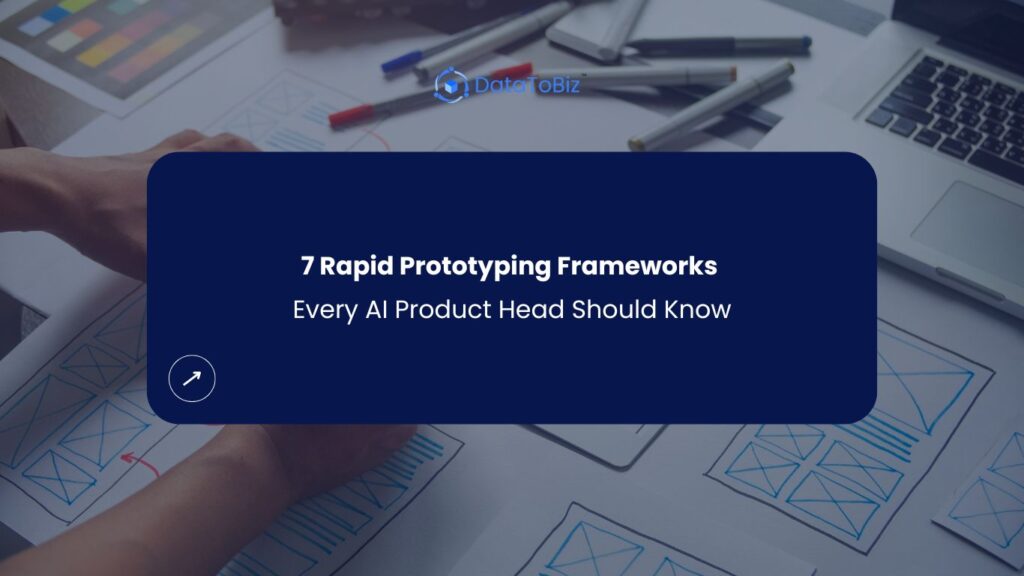
AI product development can be streamlined and accelerated without compromising quality or efficiency. Here, we’ll read about the seven rapid prototyping frameworks every product head from an AI-first company should know.
Artificial intelligence is among the major technologies in today’s world used for diverse requirements. Businesses are actively embracing AI and investing in the technology to streamline their operations, automate workflow, increase efficiency, reduce costs, and gain a competitive edge.
Statistics show that the global AI market is projected to reach $1.2 trillion by the end of 2025. While the global spending on AI-related technologies is expected to touch $350 billion, $130 billion will be invested in AI-focused R&D. Moreover, 75% of businesses will integrate AI into their systems and operations for greater efficiency.
In such instances, there’s a growing demand for innovative AI products, such as AI agents, chatbots, generative AI tools, copilot solutions, and more. Additionally, artificial intelligence is used to accelerate product development as well as prototyping. With such vast benefits, it’s no surprise that businesses are turning to rapid prototyping to quickly convert their ideas into tangible products.
In this blog, we’ll read more about a few popular rapid prototyping frameworks and how AI product development companies can help you achieve your objectives.
What is Rapid Prototyping?
Rapid prototyping refers to the method and development of creating a model of a product quickly, in part or in full, to test and validate the design, features, capabilities, etc. The main purpose of rapid prototyping is to speed up the initial iteration process to reduce the costs compared to traditional product development processes. Rapid prototyping of AI products allows your teams to quickly test the idea, identify the glitches and issues, and resolve them early. This ultimately results in fast AI deployment while ensuring that the final product is of better quality and can be released into the market for customers/ end users.
Simply put, it is about fast-forwarding the trial-and-error process to determine if the product idea and design can deliver the expected outcome. Instead of spending weeks and months on it only to realize the design may not work, you can get the answer in a few days or a couple of weeks through rapid prototyping. You switch from manually performing each step to automating it using AI and ML technologies.
Typically, rapid prototyping frameworks are aimed at gathering valuable insights about the product to make the required changes to its features, design, etc. You can build an in-house team to handle the process or partner with an AI development company for end-to-end solutions. Broadly speaking, rapid prototyping is divided into three types: prototype, review, and refine and iterate.
Prototyping: Creating the initial draft of the AI product’s design based on your specifications and from the user’s point of view. The exact type of prototype depends on the complexity of the project, your timeline, and budget.
Review: Once the prototype is ready, it is tested and validated to check if the design aligns with your ideas and can deliver the required outcomes. This stage is all about gathering feedback to identify concerns, flaws, etc.
Refine and Iterate: Based on the feedback, the team will rework the design/ features to eliminate the issues and ensure the prototype meets the project standards and requirements and can be scaled into a full-fledged product.
Communication, collaboration, and transparency are crucial during rapid prototyping to minimize the risk of errors and delays. With the right AI product development partner, you can be assured of the best results from rapid prototyping.
Rapid Prototyping Frameworks for AI Product Development
AI prototyping frameworks deal with the use of advanced artificial intelligence and machine learning tools to automate the process of creating a product prototype. However, they are not limited to technological aspects and also include strategy formation, selecting the right partner, choosing the relevant tools, risk mitigation, etc.
As an AI-first business, you should know how to make the most of rapid prototyping to build powerful artificial intelligence solutions that align with your mission, processes, and long-term objectives.
1. Automate the Design Process
The design process is vital in prototyping. It can take many weeks when manually performed. In the rapid prototyping frameworks, you use AI and ML algorithms to automate the design process. The algorithms are trained to use the given parameters, such as functionality, user preferences, raw materials, manufacturing methodologies, etc., to create quick designs that align with your requirements. You can also hire large language model consulting services to customize an algorithm as per your needs. This speeds up the entire process of design iteration and also allows you to create more options in less time. So, it also leads to greater innovation and creativity.
2. Use Predictive Analytics to Mitigate Risks
Predictive analytics is a part of advanced analytics that uses historical data to predict possible future outcomes. It is a highly useful method to predict the potential risks in product design and its alignment with market trends and customer preferences. By using predictive analytics to derive real-time insights about the future, you can make adjustments to the product during the rapid prototyping stage. It prevents losses due to last-minute changes and glitches. From detecting anomalies to tracking performance during the prototyping and testing/ reviewing stages, predictive analytics can help in many ways.
3. Integrate AI with IoT for Real-Time Updates
Artificial intelligence and IoT (Internet of Things) devices/ sensors can be integrated across various levels in the enterprise to collect data from the source and use advanced analytics to derive real-time insights. These help in promptly identifying bottlenecks in the process and eliminating them quickly through effective measures. This is widely being adopted in industries such as manufacturing, automotive, etc.
4. Make Strategic Data-Driven Decisions
Rapid prototyping frameworks also emphasize making strategic data-driven decisions to reduce costs, shorten the production cycle, and optimize the consumption of resources. By collecting and analyzing data using AI startup tools, you can derive meaningful insights about which steps in the product design cycle are unnecessary, which processes can be automated, how to use limited resources effectively, and so on. This not only accelerates prototyping but also increases the chances of creating a high-quality prototype.
5. Facilitate Collaboration
Prototyping is not a one-person job. It involves different teams and professionals from diverse domains to collaborate, discuss, and decide. For example, designers, engineers, stakeholders, and C-level executives have to interact with each other to ensure the product aligns with the business vision, mission, and goals. Factors like the budget for scaling the product are also discussed. Hence, rapid prototyping frameworks recommend using collaborative tools and platforms where everyone can use a single or unified interface for seamless communication.
6. Automate Testing and Feedback Loop
A feedback loop is a built-in system that provides instant insights to the design and development teams. It is also used by AI and ML algorithms to learn from the outcome and feedback provided as input to make corrections and improve the results. By automating the process of testing and sending feedback in rapid prototyping, you can get real-time insights about where to make the changes and how to make the product more effective for the end users. For example, AI chatbot solutions are built with a feedback loop, which increases their accuracy over time.
7. Personalize Prototypes at Scale
The ultimate goal of rapid prototyping is to quickly design a product and validate it for large-scale production or release. By implementing AI rapid prototyping frameworks, you can not only achieve all this but also personalize the prototypes for different stakeholders, that too on scale. There is no need to start from scratch every time. AI tools and technologies enable businesses to create prototypes that can be personalized/ tailored for each user segment. This is useful in industries like banking, finance, eCommerce, digital applications, etc.
Advantages of Rapid Prototyping Frameworks in AI Implementation
Design Faster
With rapid prototyping frameworks, you can design more prototype AI models in less time while also embracing innovation. The AI tools can quickly generate an alternative model as per your input. The same thing takes days or weeks when done manually.
Optimize Resources
Streamlining workflows in the prototype design process and during the final production helps in optimizing the resources to reduce expenses and overheads at different stages. It also minimizes issues that may occur during the post-launch stage.
Greater Innovation
Many businesses partner with an experienced AI product development company for rapid prototyping to gain access to advanced artificial intelligence tools to foster creativity and come up with unique product designs that will appeal to their customers. Various methodologies, like pattern recognition, analyzing customer preferences, etc., are used.
Compliance
It is equally important to consider compliance regulations when designing a prototype. Factors like accessibility, data security, data privacy, etc., have to be considered during the early stages of development. Not only does this help with quicker resolution, but it also inspires confidence in stakeholders and investors that the product is worthy of their investment.
Conclusion
By implementing the rapid prototyping frameworks in AI product development, you can continue to be at the top of your game and release quality products into the market before competitors. The best way to ensure success is to hire AI consulting services from experienced and certified companies.
From improving time-to-market to saving costs, optimizing resources, and enhancing quality, you can enjoy several benefits of embracing AI and becoming an AI-first business. Let technology take you to new heights and promote innovation without compromising revenue or profits.
FAQs
How do rapid prototyping frameworks reduce my time-to-market?
Rapid prototyping frameworks can reduce the time-to-market by helping teams quickly identify the issues/ challenges in the product design and its features. This allows you to make the changes during the early stages of development. It reduces last-minute hassles and results in quickly launching good-quality AI products into the market.
Which prototyping frameworks are best suited for AI-driven products?
The best prototyping frameworks for AI-driven products depend on your core requirements. For example, scikit-learn is a great choice for simple ML prototyping, while TensorFlow is better suited for deep learning. Partner with a certified AI development company like DataToBiz to help you make the right decisions and achieve the desired results.
How do I decide between low-code and custom AI prototyping approaches?
Consider the following factors to decide between low-code and custom AI prototyping:
- Development costs
- Time to market
- Scalability
- Skill requirements (talent gap)
- Customization
- Data security and compliance
- Operational costs, etc.
At DataToBiz, we understand your requirements in detail and then provide a comprehensive strategic plan to help you choose the right AI prototyping approach.
What common mistakes should I avoid when running AI prototypes?
Avoid the following common mistakes when running AI prototypes:
- Not addressing biases and concerns
- Not considering model understandability
- Having unrealistic expectations
- Lack of continuous monitoring and feedback systems
- Not having the required IT infrastructure
- Ignoring the talent gap in the organization, etc.
All these mistakes can be avoided by hiring DataToBiz as your AI product development partner.
How can prototyping frameworks help secure stakeholder buy-in faster?
By implementing the rapid prototyping frameworks, you can secure stakeholder buy-in faster due to the following reasons:
- You have concrete data to clarify requirements and doubts
- You have effective feedback to take corrective steps and better the product
- Interacting with the prototypes builds confidence in stakeholders
- You can minimize risks by preventing mishaps through strategic prototype development
Do these frameworks scale beyond prototypes into production-ready solutions?
Yes, the rapid prototyping frameworks are not limited to the initial stages of development. They can be scaled to guide you in developing production-ready solutions that can be launched into the markets. With DataToBiz, you can build and scale your prototypes into successful projects.
More in AI Product Development Services Providers and Rapid Prototyping Frameworks…
AI product development services are revolutionizing how businesses use artificial intelligence, machine learning, and large language model technologies to transform their internal processes, streamline operations, automate workflows, and offer effective services to customers while optimizing costs. With a reliable AI product development company as your trusted partner, you can accelerate success and become an industry leader.
Read the links below for more information about AI product development.
LLMs in AI Development- Key to AI’s Next Breakthrough?
A Strategic Framework for AI-Integrated Data Lake Consulting
Building a Cost Effective Data Pipeline – The Intelligent Approach
Fact checked by –
Akansha Rani ~ Content Management Executive