Despite strong digital adoption and market presence, the client needed additional analytics and AI support to help internal teams turn growing volumes of financial data into timely, meaningful action. Key challenges included:
Reactive Risk Monitoring
Fraud detection and credit risk assessments were mostly reactive. The client required experienced data scientists and ML engineers to move toward more proactive, predictive risk intelligence.
Disconnected Customer Data
Customer behavior, transaction history, and risk profiles were stored across different systems. This created silos and made it difficult to build a unified, 360-degree customer view.
Rising Compliance Demands
Increasing regulatory requirements called for faster and more transparent reporting. However, limited data engineering bandwidth slowed audit preparation and reporting cycles.
Untapped Revenue Potential
Without advanced analytics capabilities, the business struggled to identify high-value customers, cross-sell opportunities, and early churn indicators.
Delayed Business Insights
Leaders relied on reports that required manual consolidation, leading to slower management decisions and heavy dependency on BI teams.
AI Capability Gap
The existing data architecture and in-house skill sets were not fully prepared to support machine learning models, advanced analytics, or scalable decision intelligence initiatives.
Our team suggested going for contract-based staff to work closely with internal delivery teams. The focus was on making financial data more connected, reliable, and actionable, and sufficient staff integration would do the work.
Enterprise Data Unification:
Engineers consolidated customer, transaction, risk, and finance data into a single, analytics-ready platform. This created a consistent data foundation across departments.
Automated Data Pipelines:
Dedicated data engineers built scalable ETL workflows to standardize, validate, and enrich financial datasets, with built-in quality checks to reduce reporting errors.
Real-Time BI & Alerts:
Power BI developers delivered executive dashboards and operational reports covering fraud monitoring, portfolio performance, liquidity tracking, and compliance KPIs, along with automated alerts for critical events.
AI-Driven Financial Intelligence:
Data scientists implemented machine learning models for fraud detection, credit risk scoring, customer segmentation, churn prediction, and revenue forecasting.
Security & Governance by Design:
Architects and governance specialists embedded role-based access controls, audit trails, and data lineage mechanisms to align with FCA, GDPR, and internal compliance standards.
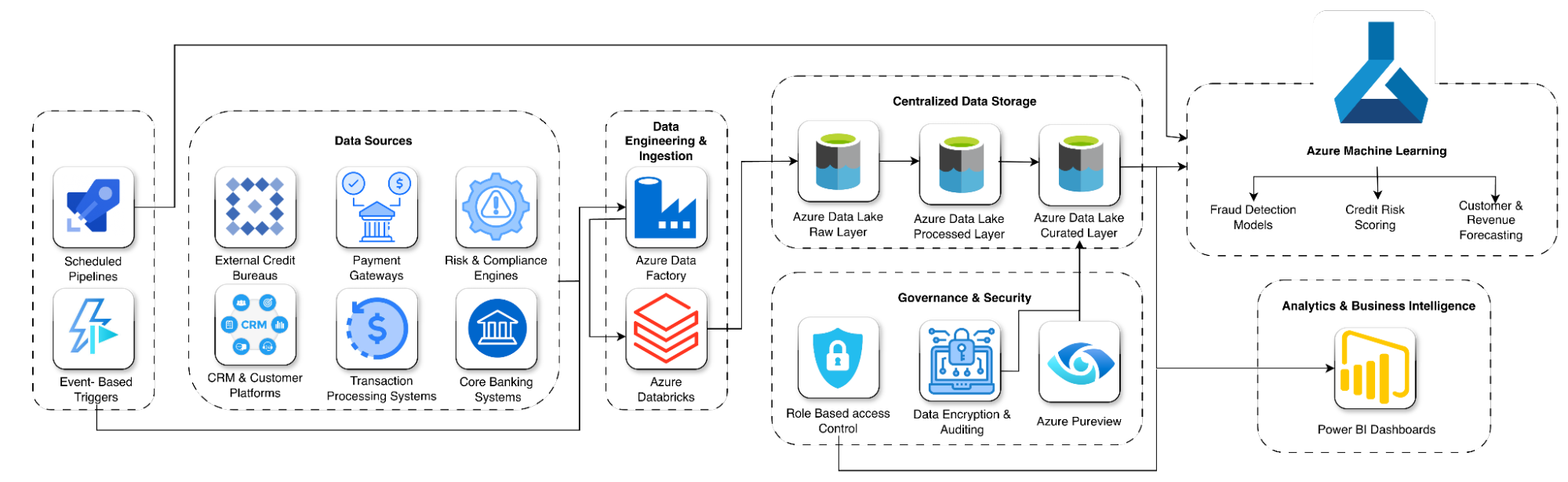
To enable enterprise-scale analytics and AI adoption, the augmented team worked within the client’s environment to set up a secure and scalable cloud-based data architecture:
Data Sources:
Core banking systems, transaction platforms, CRM, risk engines, payment gateways, and external credit bureau data were integrated into the analytics ecosystem.
Data Engineering Layer:
Azure Data Factory and Databricks were used to build and manage data ingestion, transformation, and validation pipelines.
Centralized Data Storage:
Azure Data Lake stored raw, processed, and curated data layers to support both batch and near real-time analytics.
Analytics & BI Layer:
Power BI dashboards provided visibility into fraud alerts, credit exposure, portfolio performance, and compliance metrics.
AI & Machine Learning:
Azure Machine Learning supported models for fraud detection, credit scoring, churn prediction, and financial forecasting.
Automation & Orchestration:
Event-driven workflows automated data refreshes, alerting, model retraining, and regulatory reporting processes.
Governance & Security:
Azure Purview, role-based access controls, and encryption ensured structured data governance and compliance with regulatory standards.
Stronger Fraud Detection Accuracy
AI-powered fraud models monitored 8.5 to 9 million transactions per day, improving detection precision by 21% and reducing false positives by approximately 26% within four months.
Faster Talent Onboarding
Critical data engineering and AI roles were onboarded within 2 to 3 weeks, helping the client meet regulatory and business deadlines without delays.
Accelerated Audit Readiness
Audit preparation timelines were reduced from 6 weeks to under 2 weeks, with zero material observations during review cycles.
Flexible Team Scaling
The analytics team scaled from 5 to 16 specialists during peak regulatory and delivery phases, ensuring capacity without long-term hiring overhead.
In a fast-moving financial environment, the client needed clarity at scale. By extending the AI team with DataToBiz, they strengthened fraud controls, accelerated compliance cycles, and built a data foundation ready for future AI initiatives.
What started as targeted resource augmentation evolved into a scalable analytics capability that continues to support growth across markets.
Financial Services & Banking
US
Staff/Resource Augmentation
Briefly describe the challenges you’re facing, and we’ll offer relevant insights, resources, or a quote.

Business Development Head
Discussing Tailored Business Solutions

DataToBiz is a Data Science, AI, and BI Consulting Firm that helps Startups, SMBs and Enterprises achieve their future vision of sustainable growth.
DataToBiz is a Data Science, AI, and BI Consulting Firm that helps Startups, SMBs and Enterprises achieve their future vision of sustainable growth.