Despite its scale and success, the company faced a familiar challenge shared by many large enterprises: too much reliance on IT for everything. From developing simple internal tools to automating daily workflows, every new idea had to pass through an overburdened IT department. While the teams had countless creative ideas, the execution lagged behind due to limited technical skills and mounting backlogs.
Long wait times
Teams often found themselves stuck in queues, waiting weeks for tools they needed immediately. This slowed down momentum, creativity, and everyday problem-solving.
Employees lacking coding skills
People across the company had ideas worth building, but the lack of technical skills kept them from turning those ideas into reality. Innovation stayed trapped in notebooks instead of becoming solutions.
Disconnected systems
With data scattered across disconnected systems, employees had to manually bridge the gaps. This created frustrating back-and-forth loops and wasted time that could be spent on meaningful work.
Delays in assessment
Teams often made decisions with old or incomplete information because fresh data wasn’t readily accessible. This slowed down the strategy and reduced confidence in outcomes.
Rising maintenance costs
Custom solutions became expensive to maintain and even harder to update as the company grew. What once solved problems eventually created new, costly roadblocks.
Over time, these issues began to affect morale. Teams felt slowed down, innovation lost momentum, and the company’s digital initiatives weren’t reaching their full potential. Leadership realized the solution wasn’t just about technology; it was about enabling people.
After recognising these challenges, the company partnered with us to close the gap between ideas and execution. Together, we introduced Microsoft Power Platform Copilot as a way to make innovation feel simple and within reach. With Copilot’s plain-language prompts and intuitive design, employees who had never written a line of code could finally build tools on their own, quickly, confidently, and without waiting in long IT queues.
Workflow Automation
Employees automated repetitive tasks such as reporting, data entry, approvals, and scheduling using guided Copilot suggestions. This reduced manual effort, improved accuracy, and freed teams to focus on more strategic work.
Real-Time Analytics and Visualization
Power BI Copilot dashboards gave teams immediate access to KPIs, enabling faster, more confident decision-making. Departments that previously waited days for reports could now track performance in real time.
Cross-Department Collaboration
Unified templates and shared workspaces allowed teams across HR, CRM, operations, and customer service to collaborate seamlessly. Ideas moved faster, and cross-functional projects became easier to build, test, and refine.
Rapid Adoption and Reusable Components
Ready-made templates, guided prompts, and reusable components helped employees get started quickly. What once took weeks of back-and-forth with IT could now be completed in hours, leading to smoother adoption and consistent delivery across departments.
Platform Configuration and Security
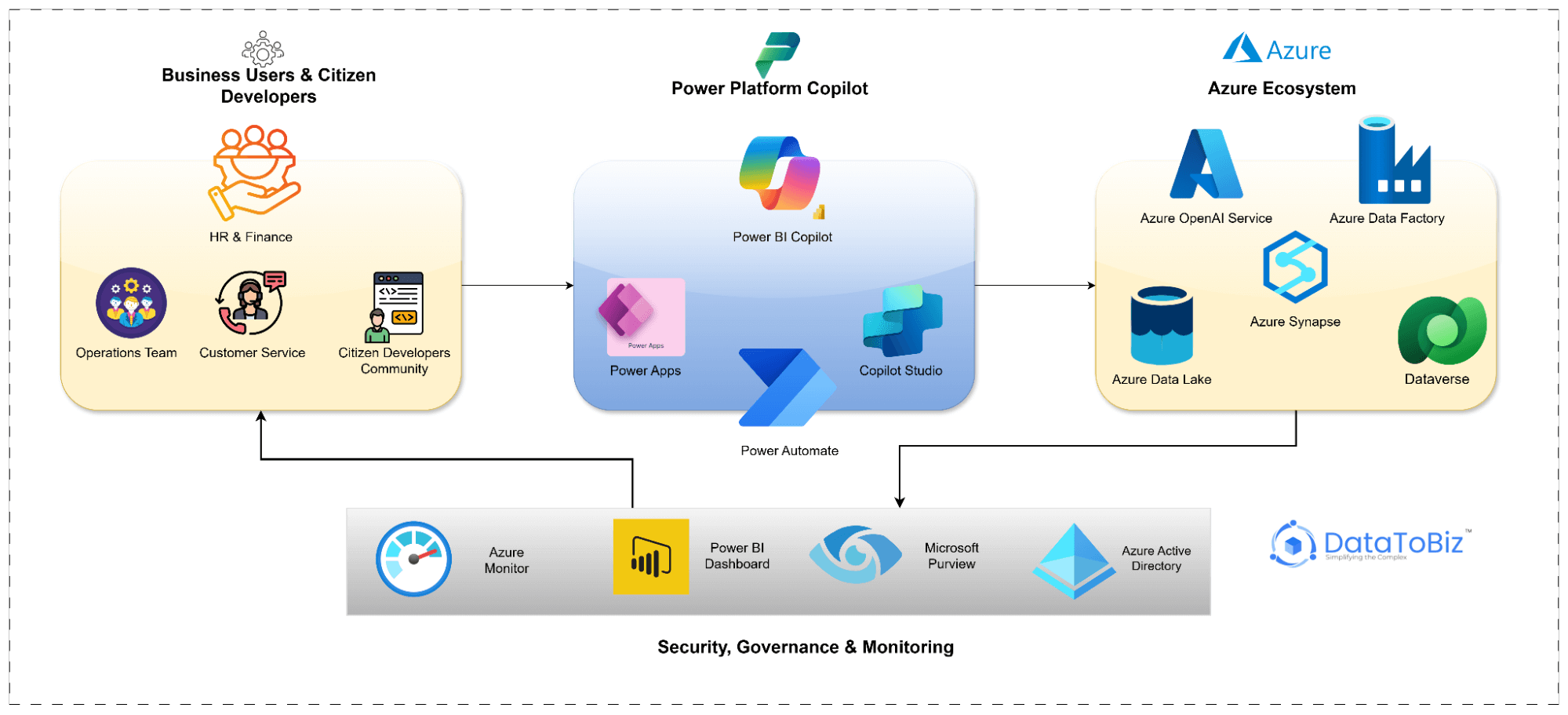
Everything began with establishing a secure and dependable base. Power Platform Copilot was configured with Azure Active Directory to manage identities safely, while Microsoft Purview handled governance, lineage, and compliance across the platform. RBAC controls and Azure Policy added an extra layer of protection, keeping the environment consistent and trustworthy as more teams joined in.
AI Enablement and Automation
Once the foundation was in place, employees started shaping their own solutions through Power Apps and Power Automate. Azure OpenAI Service powered Copilot’s natural language intelligence, helping users turn simple descriptions into functioning app components or workflow steps. Copilot Studio supported this creativity by allowing custom prompts and reusable templates that made everyday tasks even easier to automate.
Data Engineering and Integration
Behind the scenes, the data ecosystem stayed well organised and accessible. Azure Data Factory and Synapse Analytics brought data from different systems into a unified flow. Azure Data Lake and Dataverse provided structured, secure storage so every app and automation had reliable information to work with. Power BI Copilot dashboards then turned this unified data into real-time insights that leaders could act on quickly.
User Enablement and Adoption
To help teams use these tools confidently, the organisation introduced hands-on workshops and guided learning sessions. These moments of curiosity and exploration gradually created a strong citizen developer culture. People started sharing ideas, testing small projects together, and building a sense of shared innovation across departments.
Governance, Quality and Monitoring
As adoption increased, monitoring and quality checks became essential. Azure Monitor worked alongside Power BI dashboards to track productivity gains, AI accuracy, and ROI across the organisation. This transparent approach ensured that innovation stayed measurable, sustainable, and aligned with business goals.
This five-layered structure balanced governance, intelligence, and empowerment, making it easier for teams to build, automate, and innovate while keeping the entire environment secure and future-ready.
Faster App Development
App development became almost 40 % faster with the support of AI-assisted workflows, helping teams turn ideas into working solutions much sooner.
Better Productivity
Productivity rose by 35 % as manual, routine work was reduced and people finally had time to focus on what genuinely mattered.
Reduced backlogs
IT backlogs reduced by 35 % giving technology teams the freedom to prioritise strategic work and support the organisation more effectively.
More efficiency
Workflow efficiency improved by around thirty percent across departments, creating smoother handoffs and a more seamless way of getting work done.
Increased employee satisfaction
Employee satisfaction increased by almost twenty percent as people felt empowered to create their own tools and shape how their work evolved.
Via the implementation of Microsoft Power Platform Copilot, designed and delivered by DataToBiz, the client successfully built a citizen-led innovation ecosystem that bridged business and technology. The AI-driven low-code framework accelerated digital initiatives, optimized workflows, and empowered employees, positioning the enterprise as a future-ready, innovation-focused organization in the Australian telecom sector.
Retail & E-commerce
Australia
End to End Project Lifecycle Management
Briefly describe the challenges you’re facing, and we’ll offer relevant insights, resources, or a quote.

Business Development Head
Discussing Tailored Business Solutions

DataToBiz is a Data Science, AI, and BI Consulting Firm that helps Startups, SMBs and Enterprises achieve their future vision of sustainable growth.
DataToBiz is a Data Science, AI, and BI Consulting Firm that helps Startups, SMBs and Enterprises achieve their future vision of sustainable growth.