The organization was facing several challenges in scaling software development effectively as engineering efforts expanded across distributed global teams. These limitations slowed delivery velocity, introduced quality risks, and made it difficult to maintain consistency and governance at scale.
Lengthy development cycles:
Teams spent significant time on repetitive coding patterns, environment setup, and framework configuration, slowing feature releases and time to market.
Inconsistent engineering standards:
Variations in coding practices across teams led to longer review cycles, increased rework, and inconsistent quality across releases.
Complex onboarding for new engineers:
New developers required extended ramp-up time to understand internal frameworks, tools, and workflows, impacting productivity and delivery timelines.
Distributed collaboration challenges:
Engineering teams operating across multiple time zones faced coordination gaps, delayed feedback loops, and fragmented ownership.
Governance and quality risks:
Managing thousands of daily code commits without standardized controls increased the risk of defects, regressions, and compliance issues.
Post discussion, our engineering and AI teams introduced an AI-assisted development approach focused on consistency, speed, and responsible adoption. The objective was to simplify day-to-day development while supporting scale across distributed teams.
AI-assisted development foundation
GitHub Copilot and OpenAI Codex were integrated into existing workflows to reduce repetitive coding and manual effort, allowing engineers to focus on higher-value work.
Standardized coding practices
AI-guided patterns aligned with internal best practices helped improve code consistency, reduce rework, and shorten review cycles across teams.
Faster onboarding and collaboration
Context-aware AI suggestions supported quicker ramp-up for new engineers and smoother collaboration across time zones.
Responsible AI governance
Clear usage guidelines, checkpoints, and controls were implemented to ensure secure, compliant, and accountable use of AI.
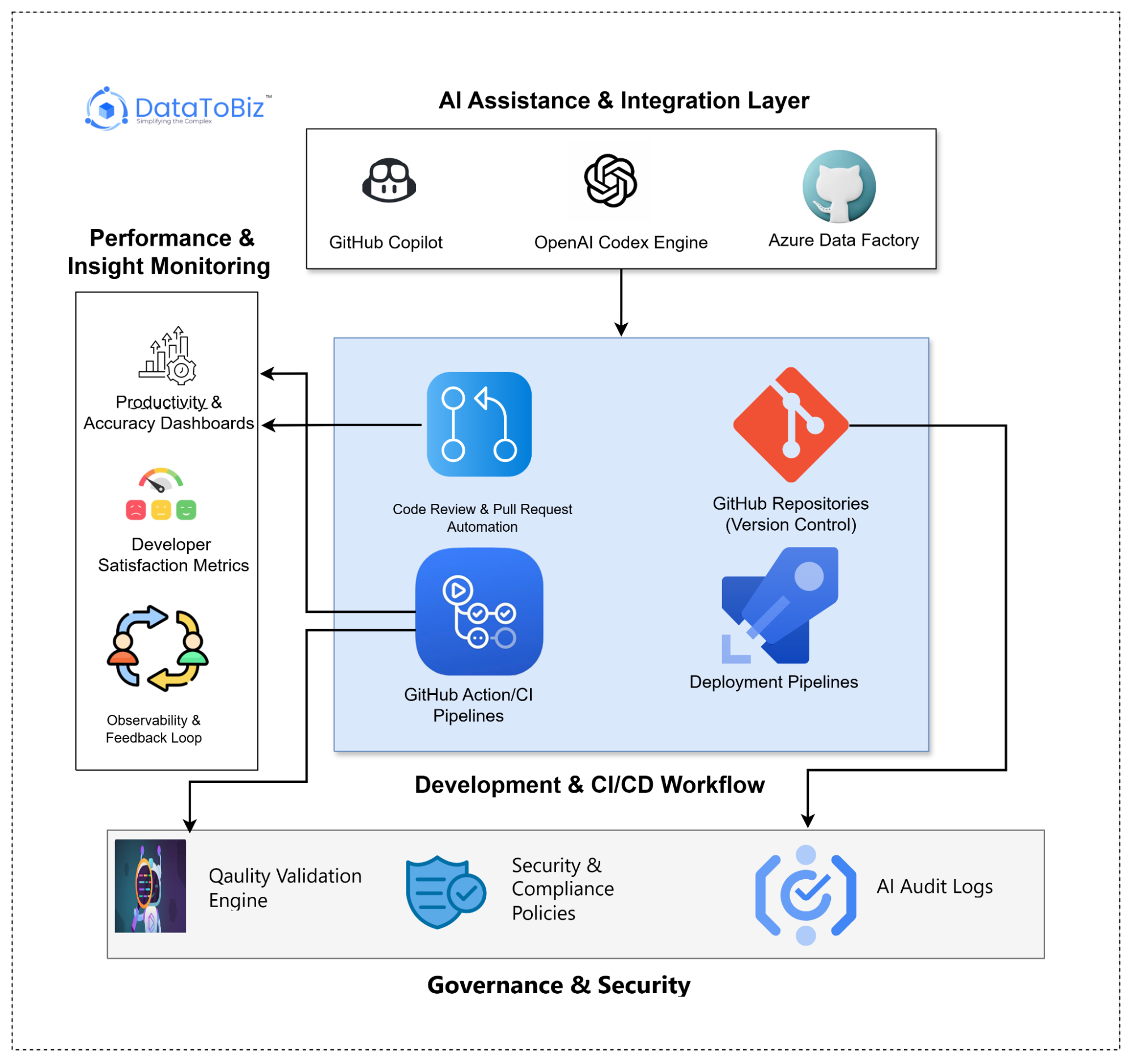
The technical deployment unified GitHub Copilot, OpenAI Codex, and the client’s Azure-based CI/CD and data engineering ecosystem within a secure, governed AI development framework. The solution focused on accelerating code creation, improving quality, and maintaining compliance across the software lifecycle.
AI integration & enablement
GitHub Copilot was embedded into developer IDEs to support contextual code generation. OpenAI Codex, integrated via Azure OpenAI Service, enabled responsive, multi-language development and faster adoption through focused enablement sessions.
Data pipelines & automation
Azure Data Factory and Synapse Analytics were used to orchestrate pipelines, consolidate commit and build data, and support continuous optimization. Power Automate enabled automated CI/CD actions and approvals.
Copilot-driven workflows
Copilots were configured across IDEs, DevOps dashboards, and documentation tools. Power BI Copilot provided real-time visibility into development KPIs, while Copilot Studio enabled reusable, standards-aligned prompts.
Governance & compliance
Microsoft Purview ensured traceability of AI-assisted code. Azure AD, Azure Policy, and DevSecOps scanners enforced secure access, compliance checks, and automated validation.
Monitoring & insights
Azure Monitor and Log Analytics tracked pipeline health and performance. Power BI dashboards captured productivity, AI usage, and improvement signals to refine Copilot behavior.
Faster development cycles
Intelligent code suggestions helped teams complete commit cycles about 15% faster, reducing wait times between build, review, and release.
Higher developer productivity
By minimizing repetitive manual tasks, overall developer productivity improved by nearly 20%, allowing engineers to spend more time on meaningful problem-solving.
Quicker onboarding for new engineers
Context-aware AI guidance shortened onboarding time by roughly 30%, helping new developers become productive much sooner.
Smoother code reviews
Standardized, AI-assisted code outputs reduced review bottlenecks and rework, improving flow and consistency across teams.
Improved developer experience
With less friction in daily work, engineers reported higher satisfaction, creativity, and focus on innovation.
Together, these integrations of GitHub Copilot and OpenAI Codex led to a measurable uplift in development velocity, code quality, and overall engineering confidence, creating a strong foundation for continued scale and innovation.
Retail & E-commerce
Australia
End to End Project Lifecycle Management
Briefly describe the challenges you’re facing, and we’ll offer relevant insights, resources, or a quote.

Business Development Head
Discussing Tailored Business Solutions

DataToBiz is a Data Science, AI, and BI Consulting Firm that helps Startups, SMBs and Enterprises achieve their future vision of sustainable growth.
DataToBiz is a Data Science, AI, and BI Consulting Firm that helps Startups, SMBs and Enterprises achieve their future vision of sustainable growth.