Despite investing in multiple systems, the client was stuck in a dilemma; critical reports and insights never came fast enough, data felt scattered, and teams were left waiting on IT for even the simplest requirements. When we sat down with their finance stakeholders, these pain points surfaced clearly.
Finance teams were overly reliant on IT for report generation. Every request had to be queued and processed, creating delays and bottlenecks that slowed down decision-making across the board.
Financial data lived in multiple systems, ERP, CRM, and transactional databases, but none of them connected. This fragmentation led to inconsistencies, duplicate efforts, and siloed views of performance.
Non-technical users lacked tools to explore data or create insights on their own. Without intuitive, self-service analytics, they depended on technical teams, which further compounded the bottlenecks.
Routine reporting and compliance checks were still manual, leaving them prone to errors and time drains. What should have been quick, automated workflows became slow, resource-heavy tasks.
For the challenges, our team designed a modern financial analytics and automation framework on Microsoft Azure. The goal was simple: bring data together, empower finance users with a self-service workflow.
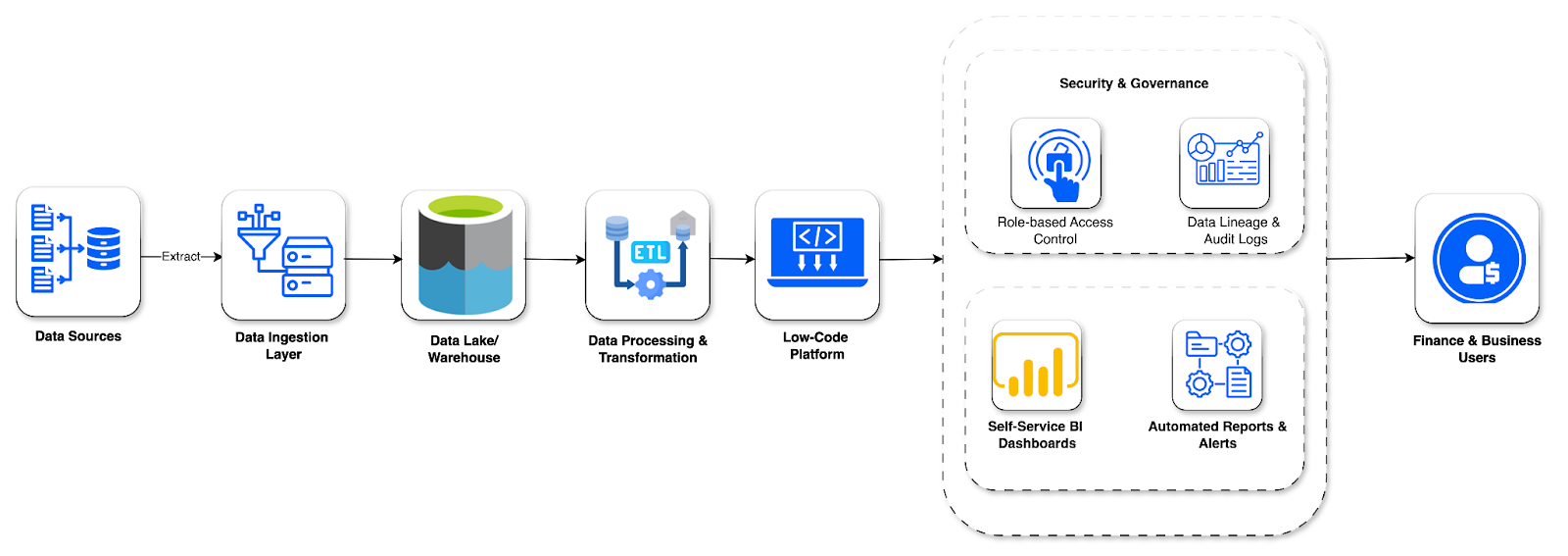
We began by consolidating financial data from ERP (Oracle Financials), CRM, and transactional databases using Azure Data Factory. This information was stored in Azure Data Lake Gen2 and organized through a Medallion architecture (Bronze, Silver, Gold) to ensure quality, consistency, and full lineage.
Next, we deployed Power BI with built-in AI features like Q&A queries and AI visuals. Pre-built finance dashboards showcased KPIs on revenue, expenses, risk, and compliance. Finance analysts could now run ad-hoc reports and explore data independently, without waiting on IT.
To reduce manual effort, we integrated Microsoft Power Automate. Key workflows, such as data refreshes, report distribution, and compliance submissions, were automated. This cut down errors, accelerated reporting, and saved valuable time for the finance team.
Finally, we focused on adoption. Our team ran hands-on workshops, created easy-to-follow guides, and established a center of excellence. This ensured finance users quickly gained confidence with self-service BI and automation tools, while also building a roadmap for advanced use cases.
Deployed on Microsoft Azure for scalability, security, and compliance with UK financial regulations. Azure Data Lake Gen2, structured with a Medallion architecture, served as the centralized repository.
Azure Data Factory ingested data from ERP (Oracle Financials), CRM (Salesforce), and transactional databases. Data transformation and cleansing were handled with Azure Databricks and PySpark.
Power BI delivered interactive dashboards with AI features and natural language queries. Incremental refresh and aggregations optimized performance for large financial datasets.
Microsoft Power Automate automated data refreshes, compliance reporting, and anomaly alerts, reducing manual effort and improving efficiency.
Azure Active Directory enforced RBAC. Data encryption, masking, and audit logging ensured compliance, while Azure Purview managed lineage and metadata.
Workshops, guides, and a Center of Excellence empowered finance teams to confidently adopt self-service BI and automation tools.
Azure Monitor and Log Analytics tracked pipeline health and Power BI usage, enabling proactive issue resolution and continuous improvement.
With self-service dashboards and automated refreshes, finance teams now generate and update reports in hours instead of days. Report turnaround time has dropped by nearly 70%, giving leadership quicker access to critical insights.
Finance analysts no longer wait on IT for every request. More than 90% of users now build and customize their own reports, strengthening data ownership and reducing bottlenecks.
Manual compliance tasks that once consumed days are now largely automated. Workflows built with Power Automate cut effort by around 60%, allowing teams to focus more on strategic analysis than routine reporting.
Centralized governance and automated checks minimized errors in financial reporting. With consistent, validated data pipelines, compliance reviews are smoother and decision-making is based on trusted information.
For them, this was more than a technology upgrade; it was a shift in how decisions are made and how teams work. By creating a unified, intelligent analytics ecosystem, what was once a struggle to keep up with reporting cycles has now become a foundation for data-informed decisions.
Financial Services & Banking
Europe
End to End Project Lifecycle Management
Briefly describe the challenges you’re facing, and we’ll offer relevant insights, resources, or a quote.

Business Development Head
Discussing Tailored Business Solutions

DataToBiz is a Data Science, AI, and BI Consulting Firm that helps Startups, SMBs and Enterprises achieve their future vision of sustainable growth.
DataToBiz is a Data Science, AI, and BI Consulting Firm that helps Startups, SMBs and Enterprises achieve their future vision of sustainable growth.