The educational organization was facing several challenges with its existing assessment process, which relied heavily on manual effort and traditional evaluation methods. These limitations slowed down academic workflows and made it harder to deliver timely, consistent, and personalized learning experiences.
To address these challenges, our team at DataToBiz implemented a structured, AI-powered evaluation system that digitized each step of the assessment workflow while keeping teachers at the center of the process.
Handwritten text capture
OCR was used to convert handwritten answer sheets into machine-readable text. Preprocessing steps such as noise removal and alignment correction were applied to improve extraction accuracy.
AI-based answer evaluation
The evaluation engine used LLMs to compare student responses against uploaded answer memos. The setup supported both objective and subjective questions, with built-in understanding for English and Afrikaans.
Teacher review and final control
A review interface allowed teachers to see student answers alongside AI-suggested scores. Teachers could adjust marks, add comments, and finalize evaluations, ensuring full control and transparency.
Digital annotations on answer sheets
Computer vision techniques enabled visual marking directly on scanned answer sheets, including highlights, comments, and scores.
Feedback generation
The system generated structured, section-wise feedback to support consistent evaluation and learning insights.
Reporting and access
Reports were generated automatically in standard formats and shared through secure access, with temporary storage and cleanup policies applied.
System architecture and security
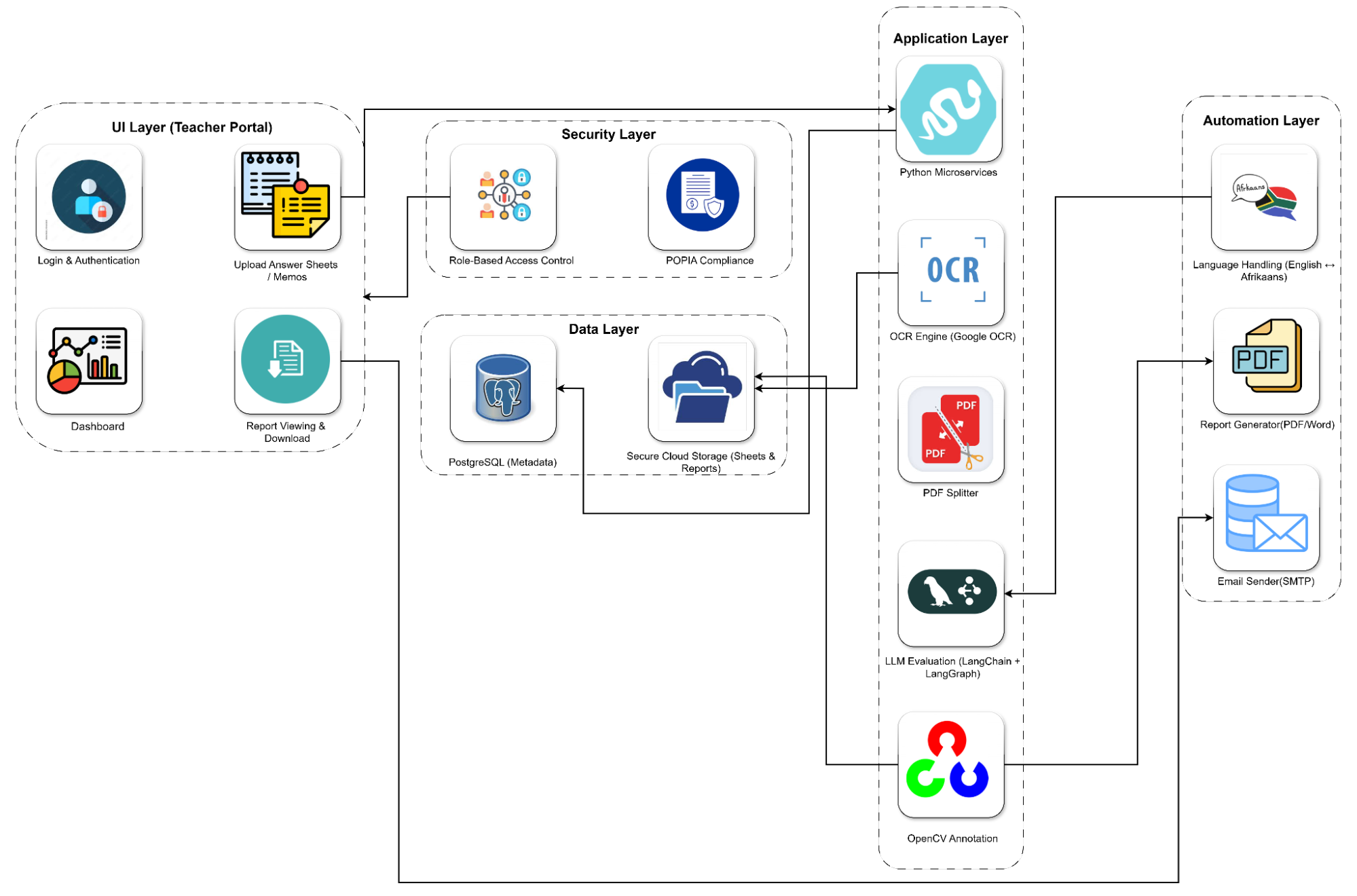
Our team designed a secure cloud-based architecture with role-based access control for teachers and administrators. Data handling followed POPIA guidelines, with controlled storage, defined retention policies, and encrypted processing for all uploaded answer sheets and generated reports.
AI and OCR enablement
Handwritten text extraction was enabled using Google OCR, optimized for classroom answer sheets. LLM-based evaluation was implemented using LangChain and LangGraph, with carefully designed prompt templates to ensure consistent scoring logic. The system supported evaluation in both English and Afrikaans.
Backend engineering and data processing
The platform was built using Python-based microservices to handle OCR, evaluation, reporting, and workflow orchestration. PostgreSQL stored structured metadata and processing logs, while OpenCV was used to annotate scanned answer sheets. Uploaded PDFs were automatically segmented by student and question to streamline processing.
Reporting and workflow automation
Report generation and delivery were fully automated. The system produced annotated answer sheets, student reports, and class summaries in configurable formats, with bilingual output where required. Secure email delivery and automated workflow triggers handled uploads, processing, and report distribution.
Teacher portal and user interface
An intuitive teacher portal was developed to support guided uploads of answer sheets, memos, and question papers. Teachers could manage class settings, language preferences, notifications, and access reports through a simple dashboard.
User enablement and rollout
To support adoption, step-by-step training sessions were conducted for teachers. User acceptance testing was carried out with real classroom scenarios, followed by a monitored rollout and post-launch support to ensure smooth ongoing usage.
Faster assessment cycles
Automated marking and workflow orchestration reduced overall evaluation time by nearly 70 to 80%, allowing teachers to complete assessments in hours instead of days.
Reliable text extraction and evaluation
Handwritten text extraction achieved close to 90% accuracy, providing a strong foundation for consistent AI-based evaluation across both objective and subjective responses.
Quicker, more meaningful feedback
With reports generated automatically, feedback and results reached students about 60% faster, helping learning cycles move without long delays.
Reduced manual errors
Standardized evaluation logic and AI assistance lowered manual marking errors by around 50%, improving fairness and consistency across classrooms.
Improved teacher productivity
Automation across marking, reporting, and delivery freed teachers from repetitive tasks, allowing them to focus more on instruction and student support.
Transparency and trust in scoring
Teacher review and final approval ensured full auditability, with 100% traceability across evaluations and clear visibility into how scores were assigned.
With the intelligent marking system in place, these outcomes helped create a faster, more consistent, and teacher-friendly assessment process that improved both operational efficiency and feedback quality for the edtech clients.
Education & EdTech
Asia-Pacific
End to End Project Lifecycle Management
Briefly describe the challenges you’re facing, and we’ll offer relevant insights, resources, or a quote.

Business Development Head
Discussing Tailored Business Solutions

DataToBiz is a Data Science, AI, and BI Consulting Firm that helps Startups, SMBs and Enterprises achieve their future vision of sustainable growth.
DataToBiz is a Data Science, AI, and BI Consulting Firm that helps Startups, SMBs and Enterprises achieve their future vision of sustainable growth.