Don't Scale on a Weak Foundation

Reimagining healthcare ops through intelligent financial and inventory analytics

About Client

  • A MENA-based, leading healthcare conglomerate with operations across 7 countries and a vast network of 366+ medical establishments, including hospitals, clinics, and pharmacies.
  • The company is known for serving millions of patients across the region and providing accessible, high-quality healthcare delivery at scale.

Problem STATEMENT

The client was facing multiple data-driven bottlenecks that were holding back operational efficiency, financial accuracy, and inventory performance across the organization.

  • Limited sales and inventory visibility: The absence of real-time insights into sales and stock levels across warehouses made it difficult to track demand, manage replenishment, and avoid stock mismatches. 
  • Excess and unused inventory: Poor visibility into slow-moving and unused stock led to higher wastage and avoidable operational costs. 
  • Underutilized data across teams: Data remained fragmented across departments, resulting in missed insights and decisions that were largely reactive instead of strategic. 
  • Delayed financial reconciliation: Manual processes caused financial closures and reconciliations to stretch over 1 to 2 months, impacting reporting speed and reliability.
  • Weak forecasting and optimization: Despite access to large volumes of data, the organization struggled to turn it into actionable insights for forecasting, planning, and optimization.

Solution

For this transformation, the team at DataToBiz rolled out a structured, phase-wise approach, introducing an integrated analytics and AI stack designed around accuracy, automation, and cross-department visibility. 

  • Smarter financial reconciliation: AI and data analytics were built into the reconciliation process to automatically match transactions across systems, improving accuracy to nearly 95% and significantly reducing manual intervention. 
  • Faster, automated close cycles: What once took 1 to 2 months was streamlined through automation, enabling teams to complete reconciliations in just a few clicks and accelerate financial closures. 
  • Inventory insights to reduce wastage: Custom inventory analytics modules were developed to identify unused and slow-moving stock, helping teams take timely action and minimize resource wastage.
  • Unified data across departments: A centralized analytics layer connected finance, inventory, and operations, allowing data to flow seamlessly across teams and giving leadership a consistent, real-time view for better decision-making.


Technical Implementation

Our technical approach was direct and ensured scalability:
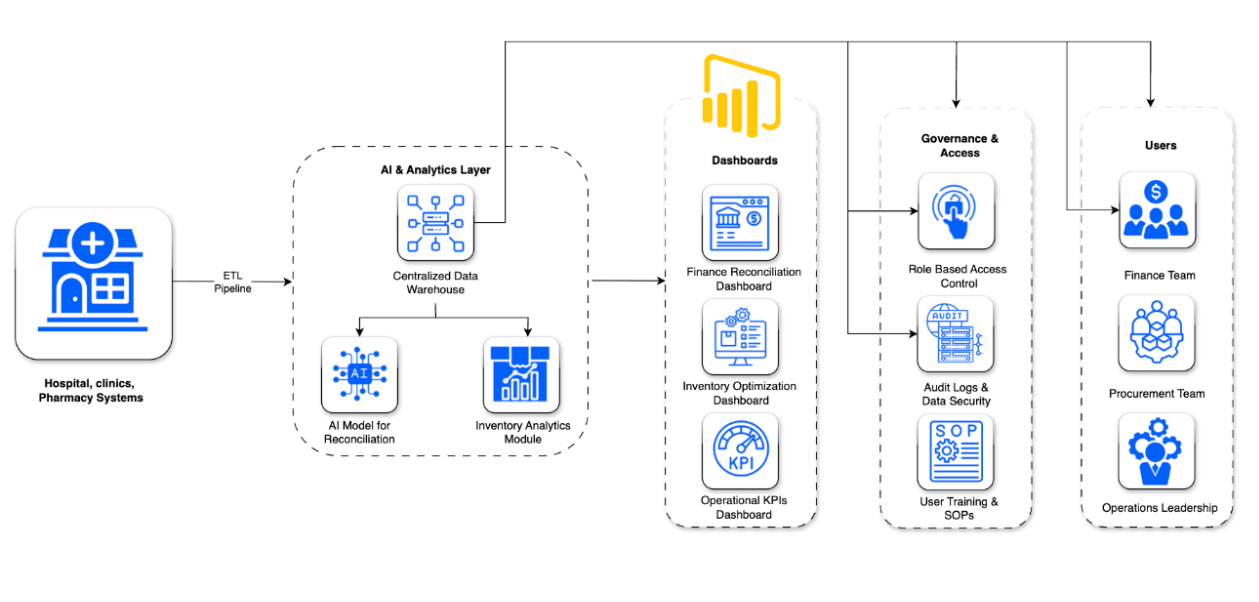
Architecture & Analytics Layer

  • Designed a central data warehouse aggregating data from hospitals, clinics, and pharmacies. 
  • Integrated AI models and reconciliation logic via scheduled ETL workflows.

Dashboarding & Reporting

  • Developed real-time dashboards with financial metrics, reconciliation status, and inventory KPIs. 
  • Enabled role-based views for financial controllers, procurement heads, and admin teams.

Governance & Handover

  • Established data governance with defined access roles and SOPs. 
  • Delivered training, documentation, and model explainability sessions for internal enablement.

Technical Architecture

Reimagining healthcare ops through intelligent financial

Business Impact

Faster reconciliation cycles
What earlier took one to two months was reduced to a matter of minutes. By automating reconciliation workflows, teams were able to close cycles nearly 90% faster, freeing up time for analysis instead of manual checks.

Improved accuracy in financial matching
With AI embedded into the reconciliation process, transaction matching became far more reliable. The system consistently delivered close to 95% accuracy, strengthening confidence in financial reports and reducing the need for rework.

Clearer inventory visibility
Centralized inventory analytics gave teams a real-time view of stock movement and unused inventory. This helped optimize inventory planning and significantly reduce operational losses caused by overstocking and wastage.

More confident decision-making
Standardized data models and intuitive dashboards brought consistency across departments. Leadership could access timely insights and act faster, with greater confidence, instead of relying on delayed or fragmented reports.

This engagement marked a shift from fragmented data and manual effort to a more connected, intelligent way of working. By embedding analytics and AI directly into core processes, the organization gained clarity, speed, and confidence in how it operates day to day. What emerged was not just better reporting, but a foundation for smarter decisions, reduced waste, and a healthcare system that can scale with purpose and precision.

Related Case Studies

Drop Your Business Concern

Briefly describe the challenges you’re facing, and we’ll offer relevant insights, resources, or a quote.

Ankush

Business Development Head
Discussing Tailored Business Solutions

DMCA.com Protection Status