
During initial discussions, the client faced multiple challenges in scaling AI adoption beyond isolated automation use cases. These challenges limited their operations and overall technology efficiency.
Lack of coordination layer:
The existing AI implementations were mostly single-agent or rule-based, operating in silos in claims processing, patient interaction, and internal operations. There was no coordination layer to allow the AI to work in coordination with other AI agents or to facilitate the execution of multi-step processes in a seamless manner.
Manual workflows in critical processes:
Critical processes like claims validation, patient query handling, and care coordination involved continuous human intervention to route processes, validate results, and manage inter-process dependencies, thereby affecting process efficiency and operational costs.
Limited contextual understanding in decisions:
The existing AI implementations lacked the contextual understanding of the processes. There was no contextual understanding in decision-making, resulting in repetitive processes, inconsistencies in results, and inefficiencies in handling multi-step processes in healthcare operations.
Scalability challenges due to complexity in workload:
The existing AI implementations were found to have challenges in scaling up to accommodate the increasing complexity in the workload. Adding new processes or use cases involved significant manual efforts.
Throughout the process of conducting the discovery workshop and solution design, the AI consultants at DataToBiz developed and implemented a multi-agent AI system to cater to the needs and requirements of the client’s business:
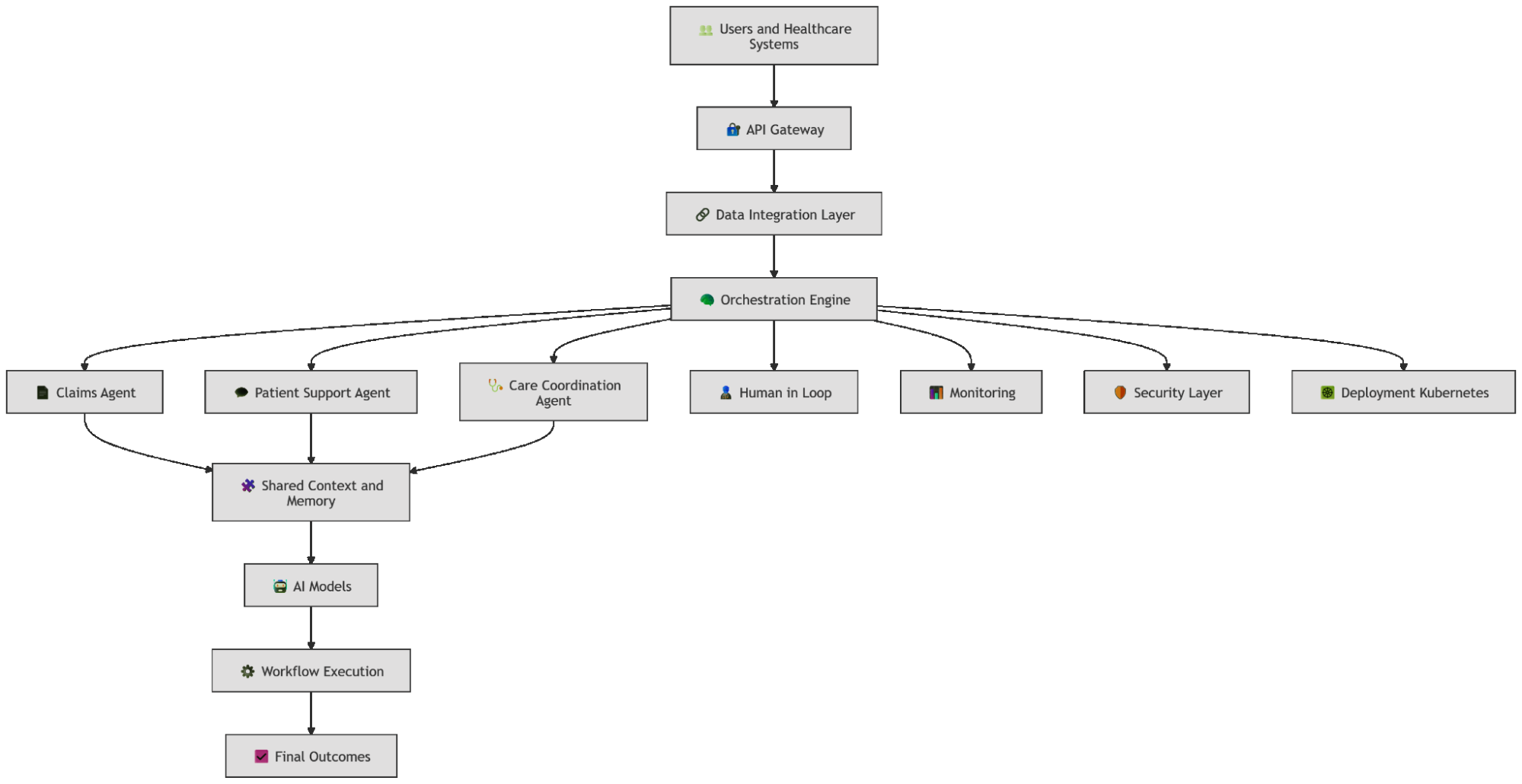
Multi-Agent Architecture Design: The team of AI developers created an organized system of multiple AI agents, each designed to perform and accomplish a set of distinct tasks such as data acquisition, data validation, agent testing, and execution.
Orchestration and Communication Layer: The team later designed an intelligent orchestration system that allowed these agents to interact and communicate with one another to accomplish complicated workload-based tasks without human intervention.
Context Management and Memory: We then shifted to designing agents that could be context-aware and had short-term and task memory, which helped in retaining data and making decisions.
Dynamic Workflow Automation: The team replaced static rule-based workflow systems with dynamic workflows that could be controlled by the agents to determine the flow and sequence of tasks to be executed.
Human-in-the-Loop Integration: The team of AI developers at DataToBiz designed and developed the system to incorporate human involvement in critical decision-making processes, along with department-level stakeholders in the healthcare company.
Performance Monitoring and Optimization: The team designed and developed a system to monitor the performance and efficiency of the agents.
The solution was implemented using a modular, scalable AI architecture designed for flexibility, performance, and enterprise integration:
Agent Framework:
Custom multi-agent framework leveraging LLM-based agents for reasoning, task execution, and decision-making across workflows.
Orchestration Engine:
LangChain and graph-based orchestration frameworks were used to manage agent interactions, task routing, and execution flows.
Data Integration:
Secure APIs and enterprise connectors were used to integrate with healthcare systems, claims platforms, and internal operational tools, enabling real-time data exchange across agents.
Context and Memory Management:
Vector databases and session-based memory layers were implemented to store and retrieve contextual information for ongoing workflows.
AI Models:
Advanced large language models were used for natural language understanding, reasoning, and task coordination across agents.
Security and Compliance:
Role-based access controls, data encryption, and secure API gateways were implemented to ensure compliance with healthcare data regulations and safe handling of sensitive information.
Deployment and Scalability:
Containerized deployment using Kubernetes enabled scalable execution of agents based on workload demand.
Monitoring and Observability:
Centralized logging, tracing, and performance monitoring tools were implemented to track agent behavior, workflow efficiency, and system health.
Reduced Operational Hands
Manual intervention across claims processing and patient support workflows decreased by 30 to 35%. Tasks that previously required 120+ operations executives for validation, routing, and followups were streamlined into AI-assisted workflows, with leaner teams of 75 resources now handling exception management and critical decision points.
Faster Workflow Turnaround
End-to-end process execution time improved by 27%, reducing average claims processing cycles from 24-36 hours to under 18-24 hours, and enabling quicker resolution of patient queries.
Improved Decision Consistency
Context-aware processing and multi-step validation reduced discrepancies in claims handling and support workflows, leading to more consistent and reliable outcomes across departments.
Scalable Automation Framework
The multi-agent architecture enabled rapid onboarding of new workflows, reducing implementation timelines for additional use cases from several weeks to a few days with minimal reconfiguration.
Enhanced Process Visibility
Centralized orchestration across agents improved cross-functional coordination, allowing teams to track workflow status, dependencies, and exceptions in real time, significantly reducing operational bottlenecks.
Stronger Adoption of AI Systems
With structured human-in-the-loop controls and transparent agent decision flows, business teams increasingly relied on AI-backed processes, leading to higher adoption across operations, support, and compliance functions.
Conclusion
With DataToBiz’s expertise in implementing multi-agent systems, the journey with AI implementation was not just about automation; it was about building a scalable platform for continuous improvement in claims, patient services, and care for the US-based healthcare operator. The result was a future-proofed system in which internal stakeholders, C-suites, and AI work in harmony.
Healthcare & Life Sciences
US
End to End Project Lifecycle Management
Briefly describe the challenges you’re facing, and we’ll offer relevant insights, resources, or a quote.

Business Development Head
Discussing Tailored Business Solutions

DataToBiz is a Data Science, AI, and BI Consulting Firm that helps Startups, SMBs and Enterprises achieve their future vision of sustainable growth.
DataToBiz is a Data Science, AI, and BI Consulting Firm that helps Startups, SMBs and Enterprises achieve their future vision of sustainable growth.