The organization struggled with not too efficient reporting system across its sales and customer operations. These gaps slowed decision-making, reduced confidence in insights, and limited the ability to scale analytics effectively.
Fragmented Salesforce data:
Sales and customer data was spread across multiple Salesforce objects, with no unified analytics layer to bring it together.
Manual, spreadsheet-driven reporting:
Teams relied heavily on exports and Excel-based analysis, increasing effort, delays, and the risk of errors.
Limited real-time visibility:
Leadership lacked up-to-date views into sales performance, order trends, and customer behavior, often working with delayed information.
Data inconsistencies and rework:
Manual data cleaning and reconciliation led to mismatched numbers and reduced trust in reports.
Lack of centralized dashboards:
Sales teams had no single, shared view of KPIs, slowing performance tracking and follow-ups.
Restricted advanced analytics:
The absence of a consolidated data foundation limited forecasting, segmentation, and customer 360 analysis.
To address these challenges, our team worked closely with the client and their key stakeholders to deliver an end-to-end analytics solution that transformed Salesforce into a unified, insights-ready data foundation.
Centralized Salesforce data:
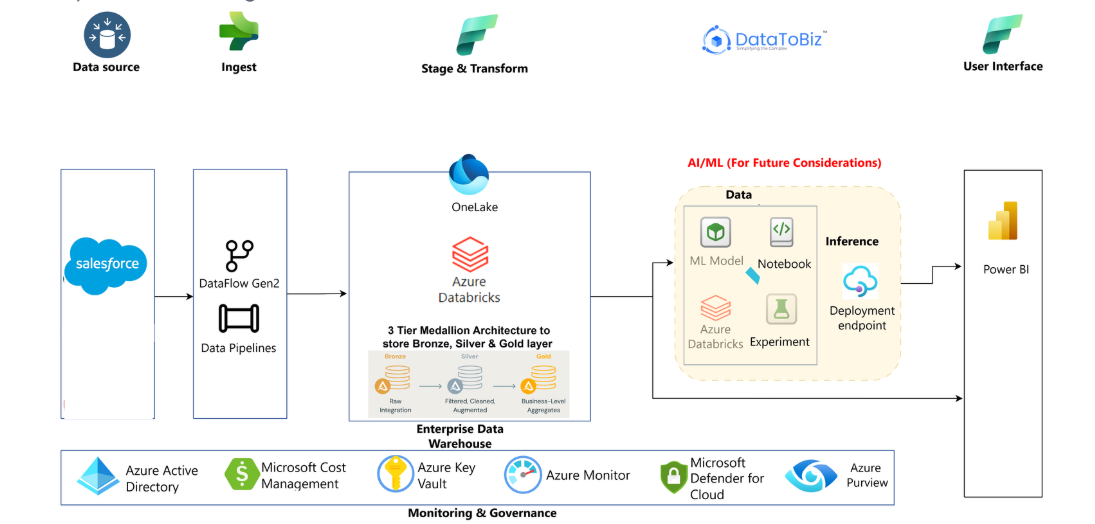
Our team partnered with business and IT stakeholders to consolidate all Salesforce objects into Microsoft Fabric using automated Dataflow Gen2 pipelines, creating a single, reliable data source.
Structured data for analytics:
Working alongside domain teams, we applied a Medallion Architecture approach (Bronze, Silver, Gold) to clean, standardize, and prepare data for consistent analysis.
Purpose-built data marts:
In collaboration with sales, marketing, and operations leaders, curated data models were built for Sales, Customer 360, Marketing, and operational performance.
Automated data quality and refresh:
Together with platform owners, data validation, refresh, and quality checks were automated to eliminate manual reporting effort and reduce inconsistencies.
Real-time reporting and dashboards:
Our BI team worked with end users to design interactive Power BI dashboards that delivered timely visibility into revenue, orders, customer behavior, and key KPIs.
Governance and scalability:
With stakeholder alignment, access controls, documentation, and governance frameworks were established to support secure adoption and long-term data management.
We executed a structured and scalable technical implementation, working closely with the client’s data, IT, and business stakeholders, to transform Salesforce data into an enterprise-ready analytics platform.
Data ingestion:
We connected Salesforce to Microsoft Fabric using Dataflow Gen2, enabling scheduled, incremental loads for key objects such as Accounts, Opportunities, Orders, Products, Campaigns, and Cases.
Bronze layer (raw storage):
Together with platform owners, raw Salesforce tables were landed in OneLake with schema preservation to support auditability and data lineage.
Silver layer (standardization):
Our engineers cleaned, validated, and standardized data using Fabric and Databricks notebooks, resolving duplicates, enforcing data types, applying business rules, and modeling object relationships.
Gold layer (data marts):
In collaboration with business teams, subject-specific marts were created for Sales Performance, Customer 360, and Operations, optimized for analytics and reporting.
Automated data pipelines:
We set up fault-tolerant pipelines with scheduled refreshes, monitoring, and alerts to ensure reliable day-to-day operations.
Power BI semantic modeling:
Our BI team designed semantic models for Sales, Customer, Marketing, and Operational KPIs using star schemas and DAX measures.
Dashboard development:
Interactive Power BI dashboards were built with drill-downs, filters, and role-based views tailored for leadership and sales teams.
Governance and security:
Azure AD role-based access, Microsoft Purview lineage tracking, and Azure Key Vault were implemented to ensure secure access and compliance.
Documentation and handover:
We delivered comprehensive documentation covering data models, pipelines, workflows, and maintenance guidelines to support long-term ownership.
Faster access to insights
Real-time Power BI dashboards enabled about 60% quicker access to sales and customer insights for day-to-day decision-making.
Improved data accuracy and trust
Standardized transformations and validation rules improved overall data accuracy by roughly 70%, increasing confidence in reports and KPIs.
Quicker leadership decisions
With centralized and consistent metrics, leadership decision-making became nearly 50% faster, supported by reliable, up-to-date insights.
Stronger business visibility
Unified dashboards increased visibility into sales performance, order trends, and customer behavior by around 65%.
Higher operational efficiency
By eliminating fragmented spreadsheets and manual reconciliations, operational efficiency improved by about 40%.
Lower dependency on technical teams
Self-service reporting reduced reliance on technical teams by nearly 75%, enabling business users to move faster on their own.
Together, these improvements helped the client move from fragmented, manual reporting to a trusted, self-service analytics environment. With Salesforce data centralized in Microsoft Fabric and insights delivered through Power BI, teams now operate with greater speed, confidence, and clarity. The organization is well positioned to scale analytics further.
Manufacturing & Industrial Engineering
US
End to End Project Lifecycle Management
Briefly describe the challenges you’re facing, and we’ll offer relevant insights, resources, or a quote.

Business Development Head
Discussing Tailored Business Solutions

DataToBiz is a Data Science, AI, and BI Consulting Firm that helps Startups, SMBs and Enterprises achieve their future vision of sustainable growth.
DataToBiz is a Data Science, AI, and BI Consulting Firm that helps Startups, SMBs and Enterprises achieve their future vision of sustainable growth.