Since adopting Power BI in 2021, the client has been working on an extensive analytics setup, 11 complex data models, including Sales Scoreboard, Production Dashboard, Job Costing Report, and Finance Dashboards, pulling data from 47 dataflows. By late 2024, this growth brought new challenges:
Slow Dashboard Refreshes
Heavy data models and complex flows were slowing down refresh times, delaying critical business decisions.
Server Bottlenecks
Fragmented models and high dataflow loads were overloading the server, creating performance issues across reports.
Licensing Inefficiencies
Excessive Fabric consumption was driving up costs, highlighting gaps in resource management.
Governance Gaps
Shared logins, weak role-based controls, and unstructured workspaces left the system vulnerable and difficult to manage.
Combined Gaps
These issues combined to increase costs, slow operations, and put data security at risk, making it harder for the client to get the insights they needed, when they needed them.
DataToBiz designed a three-phase optimization plan to address the client’s Power BI challenges and future-proof their analytics environment.
Phase 1: Audit & Planning
We started with a comprehensive review of all data models, dataflows, governance structures, and Fabric usage. The outcome was a detailed audit report highlighting quick wins, identifying risks, and providing a clear roadmap for optimization.
Phase 2: Implementation & Optimization
Next, we supported the architecture by consolidating fragmented models and optimizing refresh schedules using incremental refresh and query folding. We introduced role-based access controls and a structured workspace hierarchy (Dev/Test/Prod) to tighten security. Additionally, we right-sized licensing to reduce costs without impacting performance.
Phase 3: Support & Knowledge Transfer
Finally, we focused on training the internal team and carried out documentation while performing post-deployment performance tuning. We also laid out a scalability roadmap, preparing the client for future integration of AI insights and real-time analytics.
This phased approach not only improved performance and security but also set the foundation for a scalable BI environment.
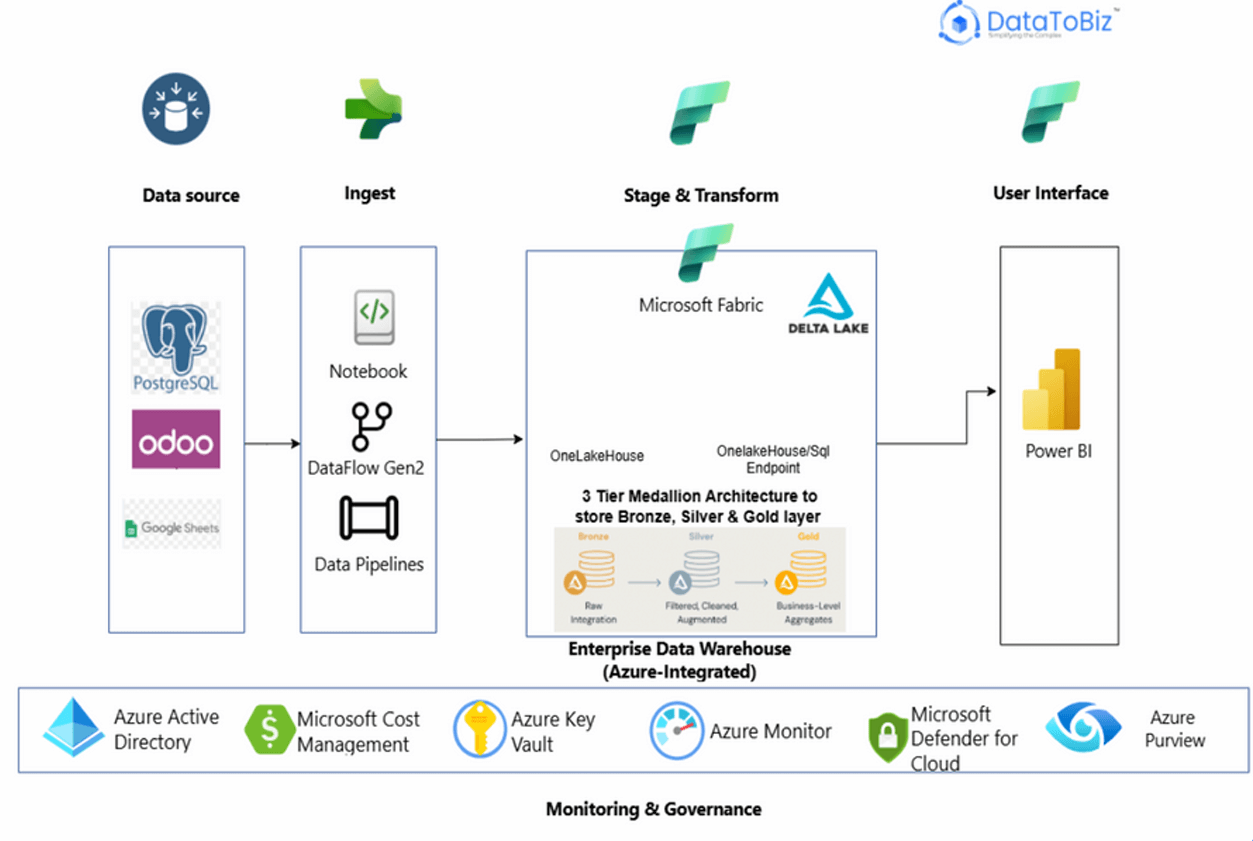
The proposed technical architecture was designed to improve efficiency, governance, and scalability:
Data Sources: Odoo ERP (AWS), Google Sheets, Google Drive
Cloud & DevOps: Dockerized services with CI/CD pipelines, monitored via Prometheus and Sentry.
Ingestion Layer: Power Automate pipelines
BI Layer: Power BI with Microsoft Fabric (right-sized capacity)
Optimization:
Governance & Security:
Scalability:
Performance Improvement
Dashboard refresh cycles became noticeably faster, and server load was significantly reduced, ensuring smoother, more reliable access to insights.
Cost Savings
By right-sizing Fabric capacity from 64 CU down to 16 CU (and in some cases 8 CU), the client achieved savings of around $6,300 per month, totaling approximately $75,000 annually.
Stronger Governance
A certified semantic model, regular quarterly audits, and enforced role-based access controls improved data security and management.
Future-proof Setup
The new architecture is future-ready, enabling real-time analytics and supporting growth without compromising performance.
Improved ROI
The client reached break-even within three months, underlining the efficiency and value of the implemented solution.
By fixing architectural issues, updating legacy components, and putting proper governance in place, the client revamped their Power BI setup into a cost-efficient, scalable, and high-performance analytics platform.
Manufacturing & Industrial Engineering
US
Briefly describe the challenges you’re facing, and we’ll offer relevant insights, resources, or a quote.

Business Development Head
Discussing Tailored Business Solutions

DataToBiz is a Data Science, AI, and BI Consulting Firm that helps Startups, SMBs and Enterprises achieve their future vision of sustainable growth.
DataToBiz is a Data Science, AI, and BI Consulting Firm that helps Startups, SMBs and Enterprises achieve their future vision of sustainable growth.