With internal IT and analytics teams focused on maintaining critical national systems, the client needed additional expertise to accelerate their AI and Big Data initiatives in line with Oman Vision 2040.
While the internal teams were strong on infrastructure, there was limited in-house experience with AI/ML use cases in healthcare, particularly in areas like medical NLP, ICD-10 coding, and predictive patient analytics.
The client had to work with diverse, unstructured datasets pulled from multiple EHR and HIS systems, requiring tailored data processing pipelines and domain-specific handling.
To meet national accessibility mandates, the client needed AI systems capable of understanding and generating insights in both Arabic and English, adding another layer of complexity to model development.
Ensuring alignment with global standards such as HIPAA and ISO/IEC 27001, while also adhering to local data governance laws, was critical to moving forward safely and legally.
Given the national importance and scope of the project, traditional hiring cycles couldn’t keep pace. The team required immediate, high-skill staff augmentation to hit delivery milestones.
All solutions needed to integrate seamlessly with the client’s existing platforms and infrastructure, minimizing disruption and ensuring continuity of care.
To help with client’s digital healthcare revamp, we deployed a cross-functional team of AI/ML Engineers, Data Scientists, and Big Data specialists. The team was responsible for building and functioning scalable AI and data solutions, fully aligned with the client’s hybrid infrastructure and compliance.
We ingested both structured and unstructured EHR data using Apache NiFi and Kafka, centralizing it in a Hadoop-based data lake. This setup was carefully tailored to work within the client’s hybrid cloud and on-premise architecture.
Our team developed advanced NLP models for clinical summarization, multilingual sentiment analysis (Arabic-English), and ICD-10 coding.
We also built predictive models for disease detection, hospital readmission risk, and resource forecasting using PyTorch and TensorFlow to handle diverse healthcare datasets.
AI services were embedded directly into the client’s Al-Shifa system via containerized REST APIs using Docker and Kubernetes.
A bilingual chatbot was also deployed across web and mobile platforms to provide EHR insights and assist with medical queries in real-time.
We implemented CI/CD pipelines, real-time monitoring, and automated retraining workflows to keep models accurate and responsive.
All systems were built to meet HIPAA, ISO 27001, and Oman’s data governance standards, ensuring full compliance and security.
To ensure long-term success, we delivered hands-on training, SOPs, and comprehensive documentation, equipping the client’s internal teams to manage, maintain, and scale the solutions independently.
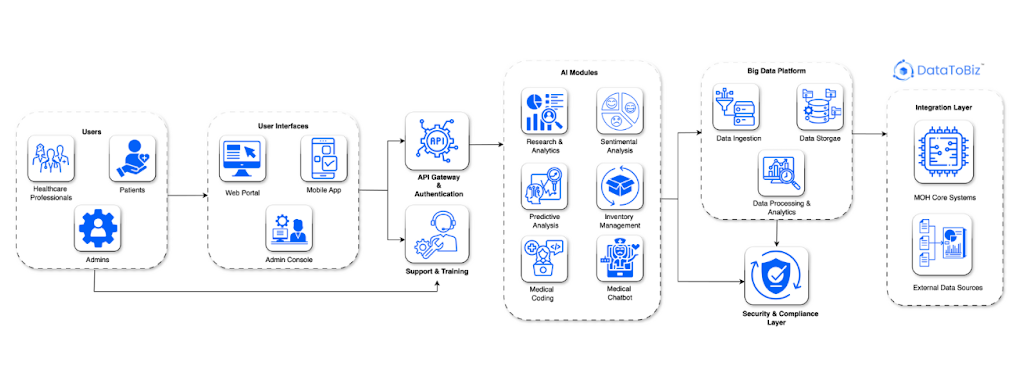
The solution was built on a hybrid architecture combining on-premise servers with Azure Cloud.
Data was ingested using Apache NiFi and Kafka into a Hadoop-based data lake, following a Medallion Architecture.
Both live and batch ingestion pipelines were set up to process data from EHRs, lab systems, and clinical notes.
NLP and predictive models were developed using PyTorch, TensorFlow, and HuggingFace for tasks like ICD-10 coding, risk prediction, and chatbot interactions.
Models were containerized with Docker and deployed via Kubernetes, with REST APIs integrated into Al-Shifa and other client platforms.
CI/CD pipelines were automated using GitHub Actions and Jenkins.
Prometheus and Grafana handled real-time monitoring and drift detection, while scheduled retraining ensured model accuracy and compliance.
Developed multilingual NLP capabilities for entity extraction, sentiment analysis, and intent classification in both Arabic and English.
Predictive analytics models were used for disease risk, patient readmission, and resource planning.
Power BI dashboards provided insights into healthcare KPIs and AI outputs.
RBAC was implemented to maintain secure, role-based access across departments and user groups.
With staff augmentation, the client was able to execute AI and Big Data modules in parallel, resulting in a 40% faster project delivery compared to initial timelines.
NLP-driven models and predictive analytics enhanced diagnostic support, contributing to a 30% increase in decision-making accuracy for targeted use cases.
Automating ICD-10 coding and sentiment analysis led to a 50% reduction in manual workload, freeing up clinical and admin teams for higher-value tasks.
Multilingual NLP models enabled real-time processing of patient feedback, improving responsiveness and service alignment, and delivering a 60% gain in actionable insight extraction.
Through hands-on training, SOPs, and documentation, internal teams were empowered to manage, scale, and evolve the AI systems, ensuring long-term independence and agility.
By embedding AI and Big Data experts into the client’s teams, we helped fast-track critical digital health initiatives. The collaboration brought real-time insights, smarter operations, and stronger patient outcomes, all while building internal capability and staying fully compliant.
Government & Public Sector
Middle East
Staff/Resource Augmentation
Briefly describe the challenges you’re facing, and we’ll offer relevant insights, resources, or a quote.

Business Development Head
Discussing Tailored Business Solutions

DataToBiz is a Data Science, AI, and BI Consulting Firm that helps Startups, SMBs and Enterprises achieve their future vision of sustainable growth.
DataToBiz is a Data Science, AI, and BI Consulting Firm that helps Startups, SMBs and Enterprises achieve their future vision of sustainable growth.